
ARTICLE: SILICOSIS CLASS ACTION – BUSINESS AND HUMAN RIGHTS ARE NOT INCOMPATIBLE
 The South Gauteng High Court today certified the class action involving former employees of mining companies. This means that former gold miners and their families can jointly sue gold mining companies for damages after contracting silicosis and tuberculosis in extracting the mineral as part of their employment duties.
This is South Africa’s largest class action, which involves 56 mineworkers representing as many as 200 000 workers or their families. The case rests on the fact that the mine workers’ health was placed at risk while in the employ of the mining companies. The mining companies are said to have known how to reduce the likelihood of inhaling the poisonous silica dust, but failed to implement measures to prevent this.
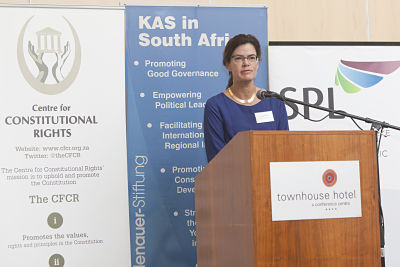 On 4 May 2016 the Centre for Constitutional Rights (CFCR) and the School of Public Leadership (SPL) at Stellenbosch University (SU), supported by the Konrad Adenauer Stiftung (KAS), hosted the second in a series of breakfast discussions for 2016. The aim of these discussions is to create a platform for conversation and debate about the Constitution and good public leadership.
 The Centre for Constitutional Rights (CFCR), based in Cape Town, is seeking the services of a Legal Officer. Reporting to the Director of the CFCR, the Legal Officer will be responsible for the following duties:
 The Centre for Constitutional Rights (CFCR) welcomes the judgment handed down by the Pretoria High Court (the High Court) in Democratic Alliance v Acting NDPP and Others. A full bench of the High Court has reached a judgment that a decision taken in 2009‚ by the then Acting National Director of Public Prosecutions, Mokotedi Mpshe, to drop 783 charges against the President, Mr Zuma, was irrational and should be reviewed and set aside. The charges relate to the Arms Deal, in which his financial adviser, Mr Schabir Shaik, was found guilty of corruption and was sentenced to 15 years’ imprisonment.
 On 27 April, South Africans will celebrate Freedom Day – set aside in order to commemorate the day that South Africa’s first multi-party democratic elections were held. While the importance of political rights cannot be downplayed – freedom also means the right of individuals “not to have obstacles to possible choices and activities”. In other words, the ability to achieve one’s fullest potential.
 It is time that the Commission’s Act was amended in order to give greater meaning to constitutional values. The Constitution enables the President, as well as Provincial Premiers, to appoint Commissions of Inquiry. This authority to appoint Commissions of Inquiry can be further delegated to allow Ministerial Commissions, as well as other Commissions at local level.
 In March 2010 the Centre for Constitutional Rights (CFCR), in line with its mission to uphold and defend the Constitution, submitted a complaint to the South African Human Rights Commission (SAHRC) on behalf of Mr Chumani Maxwele. The SAHRC has a constitutional mandate to protect, promote and monitor human rights in South Africa. The SAHRC is further empowered by the South African Human Rights Commission Act to investigate and report on the observance of human rights in the country and to take steps to secure the appropriate redress where human rights have been violated. The complaint concerned the abuse of Mr Maxwele by members of the President’s Special Protection Unit and in so doing, the violation of his constitutional rights. The President’s Special Protection Unit accused Mr Maxwele of making an obscene gesture at the President’s motorcade as it drove past him in Cape Town. Following which, the same Unit arrested and bundled him into one of the vehicles, after he was restrained and blinded using a black bag. He was detained overnight and was interrogated, all the while denying having made the gesture in question.
 1. The Centre for Constitutional Rights (CFCR) is a unit of the FW de Klerk Foundation – a non-profit organisation dedicated to upholding the Constitution of the Republic of South Africa, 1996 (the Constitution). To this end, the CFCR seeks to promote the Constitution and the values, rights and principles enshrined in the Constitution; to monitor developments including legislation and policy that may affect the Constitution or those values, rights and principles; to inform people and organisations of their constitutional rights and to assist them in claiming their rights. The CFCR does so in the interest of everyone in South Africa.
  1. The Centre for Constitutional Rights (CFCR) is a unit of the FW de Klerk Foundation – a non-profit organisation dedicated to upholding the Constitution of the Republic of South Africa, 1996 (the Constitution). To this end, the CFCR seeks to promote the Constitution and the values, rights and principles enshrined in the Constitution; to monitor developments including legislation and policy that may affect the Constitution or those values, rights and principles; to inform people and organisations of their constitutional rights and to assist them in claiming their rights. The CFCR does so in the interest of everyone in South Africa.