
ARTICLE: JUDGES V JUDGES – A NEED FOR FINALITY
 Yesterday, the Constitutional Court (the Court) in Nkabinde and Another v Judicial Service Commission and Others, ruled that a provision in the Judicial Service Commission Act meets constitutional muster. In making the ruling, the Court dismissed the application filed by Justices Nkabinde and Jafta to rescind an order previously made by the same Court. The Court further underlined that it is in the interests of justice that the complaint against Western Cape Judge President Hlophe be brought to finality.
The decision is the last hurdle which has been met and all but clears the way for the setting up of a tribunal to conduct disciplinary hearings into Judge Hlophe’s conduct. This, after a complaint of gross misconduct was laid before the Judicial Service Commission (JSC) against Justice Hlophe by all the then Justices of the Constitutional Court, including the subjects of yesterday’s ruling, Jafta and Nkabinde. They alleged that Justice Hlophe had acted improperly in trying to sway their judgments in matters with a direct bearing on the corruption charges against President Jacob Zuma. Justices Jafta and Nkabinde would have provided crucial evidence of this impropriety but they, instead, challenged the lawfulness of the tribunal that the JSC would have established. Eight years and numerous legal challenges later, it seems that this ruling will bring the matter to finality.
 On 16 August 2016 the Centre for Constitutional Rights (CFCR) hosted its first breakfast discussion in conjunction with the Centre for Human Rights (CHR) at the University of Pretoria, supported by the Konrad Adenauer Stiftung (KAS). The breakfast discussions aim to stimulate a platform for debate and dialogue about the Constitution and good public leadership.
 In the months leading up to this year’s Local Government Elections, the possibility of free and fair elections was marred by various incidents across the country. From protests in Vuwani regarding municipal demarcation, to the multiple political killings in KwaZulu-Natal, as well as the plethora of objections and complaints on election day, it was indeed unlikely that a calm political atmosphere would prevail following the release of the final results. However, after the conclusion of the voting process and the announcement of the final results, the Independent Electoral Commission (IEC) declared the elections free and fair. These sentiments have been echoed by the Law Society of South Africa.
 The Constitution protects the right of all South Africans to participate in the cultural life of their choice and further protects the cultural, religious and linguistic rights of communities, on condition that such practices are not inconsistent with any provision in the Bill of Rights. However, developments in the course of the year suggest that the rights to equality and dignity for many women in the country remain elusive, due to cultural practices.
 The Constitutional Court (the Court) has spoken – as of 28 July 2016, the Restitution of Land Rights Amendment Act 15 of 2014 (the Amendment Act) is invalid, largely due to the flawed process which led to it being passed into law by the National Assembly. The decision underscores the importance of public participation in the legislative process. After all, it stands to reason that the very people who will become the subjects of the law are not only consulted, but their views should be taken into account when crafting laws. Ultimately the decision has implications for, particularly, the Expropriation Bill, in respect of which the President has recently written to the Speaker of the National Assembly and the Chairperson of the National Council of Provinces (NCOP) to clarify procedural matters, including insufficient public participation.
 THE CONSTITUTION AND GOOD PUBLIC LEADERSHIP: BREAKFAST DISCUSSION SERIES 2016
 On Monday 25 July 2016, the Centre for Constitutional Rights (CFCR) supported by the Konrad Adenauer Stiftung (KAS), hosted a discussion at Rhodes University (RU) in conjunction with the Law Faculty as part of their running constitutional dialogue series. The aim of these discussions is to create a platform for conversation and debate about the Constitution and the values and rights contained therein. This discussion focused on the role that universities play in the building of inclusive societies, especially in the communities that they occupy.
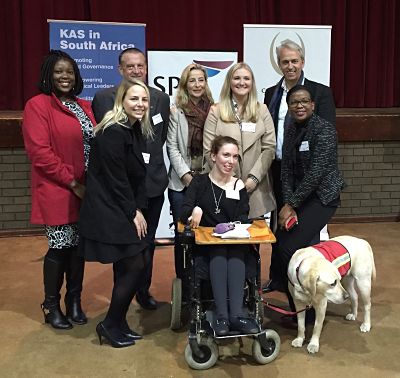 On the morning of Wednesday 20 July 2016, the Centre for Constitutional Rights (CFCR) and the School of Public Leadership (SPL) at Stellenbosch University (SU), supported by the Konrad Adenauer Stiftung (KAS), hosted a breakfast discussion as part of their running Constitutional dialogue series. The aim of these discussions is to create a platform for conversation and debate about the Constitution and good public leadership. This discussion was youth-oriented and was attended by high school learners from Bellville High School, Bernadino Heights High School, De Kuilen High School, Eerste Rivier Secondary School, the German International School, Isilimela High School, Kasselsvlei Comprehensive High School, Parow High School, Sarepta Secondary School, The Settlers High School, as well as the Cape Town Junior City Council. The breakfast was held in the Bellville High School Hall, which was graciously made available by the school.
 The Centre for Constitutional Rights (CFCR) welcomes today’s decision handed down by the Constitutional Court in the matter involving the Department of Correctional Services (the Department) and the trade union, Solidarity, as well as employees of the Department. In a nation where concepts of equality remain deeply contested, the decision lends greater assistance in clarifying what may be claimed under the notion of equality. Importantly, the decision affirms fairness as a procedural value in the implementation of any workplace employment equity policies. Ultimately, the decision means that considerations of justice and equity dictate that national government departments cannot solely rely on national demographics in order to determine the level of representation of different designated groups.