
HUMAN RIGHTS REPORT CARD 2016
 The Constitution at section 7(2) provides that the state must respect, protect, promote and fulfil the rights in the Bill of Rights. As a constitutional democracy, South Africa’s values are underpinned by considerations of human dignity, the achievement of equality, and the advancement of human rights and freedoms; non-racialism and non-sexism, supremacy of the Constitution and the Rule of Law; and a multi-party democracy to ensure a government that is accountable, responsive and transparent. Further, the Bill of Rights binds the Legislative, the Executive, the Judiciary and all organs of state. The Bill of Rights is not limited to protecting individuals against the state, but also provides in some circumstances direct protection of individuals against rights abuses by other individuals.
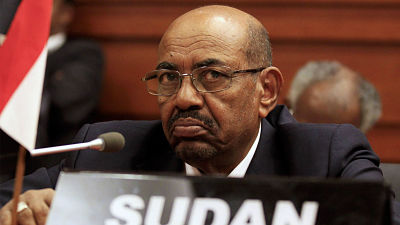 The Centre for Constitutional Rights (CFCR) welcomes the Supreme Court of Appeal’s (SCA) dismissal of the government’s appeal in the al-Bashir matter as an important affirmation of the Rule of Law. Section 2 of the Constitution establishes the Supremacy of the Constitution and provides that any law or conduct inconsistent with the Constitution is invalid and further that obligations imposed by the Constitution must be fulfilled. There is no derogation from this obligation.
 If news reports are to be believed, then the Minister of Rural Development and Land Reform, Gugile Nkwinti, intends to extend the cut-off date for land claims to include pre-1913 claims. But the Constitution explicitly provides that “A person or community dispossessed of property after 19 June 1913 as a result of past racially discriminatory laws or practices is entitled … to restitution of that property…”.
 The Expropriation Bill (the Bill) has been passed by the National Assembly and is currently on its way to the National Council of Provinces who may either accept the Bill as it is, or accept with changes, or even reject the Bill. Should it be accepted, then all that will remain will be the President’s signature and a date of commencement for there to be a new expropriation process.
 The official opposition political party has signaled its intention to introduce, in accordance with Parliament’s established Rules, a motion of no confidence in the President. This motion will be debated on 1 March 2016 by the National Assembly. The opposition party has cited the President’s decision to remove the Finance Minister, Nhlanhla Nene late last year – a decision which reportedly cost the economy R500 billion – as the driver for the decision to proceed with the motion. It is not the first time that the opposition party has attempted to have a no confidence resolution passed in the National Assembly.
 On Tuesday 16 February 2016 the Centre for Constitutional Rights (CFCR) and the School of Public Leadership (SPL) at Stellenbosch University (SU), supported by the Konrad Adenauer Stiftung (KAS), hosted the first breakfast meeting of 2016 in its Constitutional democracy and good public leadership series. As is now common knowledge from previous breakfasts, the aim of these discussions is to facilitate dialogue and debate about the Constitution and good public leadership.
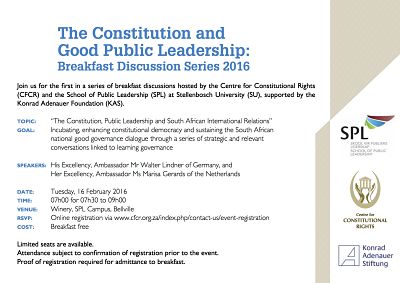 THE CONSTITUTION AND GOOD PUBLIC LEADERSHIP: BREAKFAST DISCUSSION SERIES 2016
 The uThukela District Municipality (the Municipality) in KwaZulu-Natal Province has established a “Maidens Bursary” to fund higher education for young women. That is laudable. But, that is not all. Sixteen young women who are the beneficiaries of the scholarship, are reportedly examined regularly to ascertain their virginity. The bursary is conditioned upon their remaining virgins. This, happening in 2016, in a supposedly constitutional democracy.
 The Centre for Constitutional Rights (the CFCR) wishes all its friends and supporters peace and happiness during the Festive Season and good health and prosperity for the New Year …