
 ***EVENT POSTPONED UNTIL FURTHER NOTICE***
 Our Constitution envisages a broadcasting system that operates “in the public interest” … “to ensure fairness and a diversity of views broadly representing South African society.” Furthermore, section 10(d) of the Broadcasting Act, 1999, requires that “the public service provided by the (SABC) Corporation must provide significant news and public affairs programming which meets the highest standards of journalism, as well as fair and unbiased coverage, impartiality, balance and independence from government, commercial and other interests.”
 In a media briefing following the Constitutional Court’s historic judgment, in which it ruled that the Public Protector’s report on the upgrades at President Zuma’s private Nkandla home was binding on him, and as a result he was obliged to pay money back in relation to non-security upgrades, Thuli Madonsela commented that instead of celebrating, she would only be happy if the Hawks and the National Prosecuting Authority (NPA) stopped investigating her. Although this has been denied by the two state agencies concerned, it is submitted that she would not have made such a statement without there being some tangible substance to it.
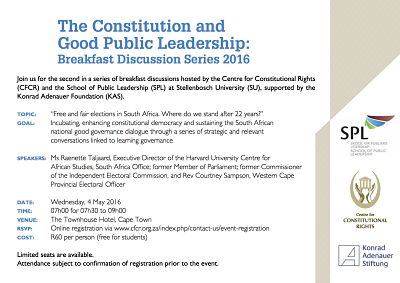 THE CONSTITUTION AND GOOD PUBLIC LEADERSHIP: BREAKFAST DISCUSSION SERIES 2016
 A constitutional crisis occurs when the Constitution is unable to resolve issues that arise within the state or when the actions of state actors – the Executive, the Legislature or the Judiciary – are irreconcilable with the precepts of the Constitution.
Such a situation arose last week when the Constitutional Court delivered its judgment on Nkandla. The highest court in the land has spoken. The President’s failure to comply with the remedial action taken against him by the Public Protector is at odds with his obligations to uphold, defend and respect the Constitution as the supreme law of the Republic. This failure too, is inconsistent with the duty to assist and protect the office of the Public Protector to ensure its independence, impartiality, dignity and effectiveness.
 The Centre for Constitutional Rights (CFCR) welcomes the unanimous Constitutional Court decision in the combined cases of Economic Freedom Fighters (EFF) v The Speaker of the National Assembly and Others and Democratic Alliance (DA) v the Speaker of the National Assembly and Others matter. The decision is an emphatic affirmation not only of the Rule of Law, but also the supremacy of the Constitution. The unanimous decision further highlights the importance of the separation of powers in a constitutional democracy, as well as the necessity of checks and balances to protect against the abuse of power. Importantly, the decision has brought clarity as to the binding nature of the Public Protector’s remedial action recommended by her Office.
 On 10 March 2016, the Supreme Court of Appeal (SCA) dismissed an appeal from the Equality Court by an Afrikaans-speaking lawyer who claimed that the failure on the part of Parliament and the Minister of Arts and Culture to publish legislation in all 11 official languages was tantamount to unfair discrimination. As an Afrikaans speaker, he felt disadvantaged because statutes are no longer published in that language. In light of the current public debate on the place and role of languages in tertiary institutes and in the civic society, the ruling lends greater understanding to the debate.
 On 18 February 2016, the Constitutional Court (the Court) handed down a resounding unanimous judgment regarding the detention of unsuccessful asylum applicants, as well as other groups of undocumented foreigners upon the breach of migration provisions. The provision concerned is section 34(1) of the Immigration Act, which requires that the concerned individuals be arrested and detained in a manner as well as place determined by the Director-General of Home Affairs.
 Monday, 21 March, marks South Africa’s celebration of Human Rights Day. The day is set aside to remind the nation of its transition from apartheid to a constitutional democracy founded on values of human dignity, the achievement of equality, and the advancement of human rights and freedoms, as well as non-racialism and non-sexism. The supremacy of the Constitution and the Rule of Law are also guaranteed. A similar guarantee exists for universal adult suffrage, a national common voter’s roll, regular elections and a multi-party system of democratic government, to ensure accountability, responsiveness and openness.