
ARTICLE: THE ROLE OF UNIVERSITIES IN BUILDING INCLUSIVE SOCIETIES
 On Monday 25 July 2016, the Centre for Constitutional Rights (CFCR) supported by the Konrad Adenauer Stiftung (KAS), hosted a discussion at Rhodes University (RU) in conjunction with the Law Faculty as part of their running constitutional dialogue series. The aim of these discussions is to create a platform for conversation and debate about the Constitution and the values and rights contained therein. This discussion focused on the role that universities play in the building of inclusive societies, especially in the communities that they occupy.
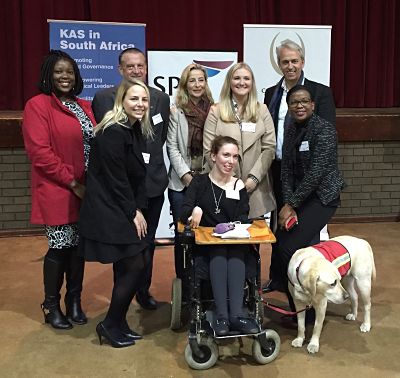 On the morning of Wednesday 20 July 2016, the Centre for Constitutional Rights (CFCR) and the School of Public Leadership (SPL) at Stellenbosch University (SU), supported by the Konrad Adenauer Stiftung (KAS), hosted a breakfast discussion as part of their running Constitutional dialogue series. The aim of these discussions is to create a platform for conversation and debate about the Constitution and good public leadership. This discussion was youth-oriented and was attended by high school learners from Bellville High School, Bernadino Heights High School, De Kuilen High School, Eerste Rivier Secondary School, the German International School, Isilimela High School, Kasselsvlei Comprehensive High School, Parow High School, Sarepta Secondary School, The Settlers High School, as well as the Cape Town Junior City Council. The breakfast was held in the Bellville High School Hall, which was graciously made available by the school.
 The Centre for Constitutional Rights (CFCR) welcomes today’s decision handed down by the Constitutional Court in the matter involving the Department of Correctional Services (the Department) and the trade union, Solidarity, as well as employees of the Department. In a nation where concepts of equality remain deeply contested, the decision lends greater assistance in clarifying what may be claimed under the notion of equality. Importantly, the decision affirms fairness as a procedural value in the implementation of any workplace employment equity policies. Ultimately, the decision means that considerations of justice and equity dictate that national government departments cannot solely rely on national demographics in order to determine the level of representation of different designated groups.
 Things appear to have come to a head at the South African Broadcasting Corporation (SABC). This, in the wake of recently made, sweeping changes to its operations. Some changes appear unconstitutional. This suggests an organisation uncertain of its role as a public broadcaster in a constitutional democracy. The fact that both the courts and the Public Protector have found that acting Chief Operations Officer (COO) Hlaudi Motsoeneng’s appointment is irrational and unlawful adds to the public broadcaster’s malaise. Additionally, news reports suggest that the SABC will, next month, announce a loss of up to R500 million – nearly double the loss of R395 million from last year. All of this paints a picture of uncertainty over the future of the SABC.
 Pockets in the City of Tshwane are beset by violence, with media reports showing burnt-out shells of motor vehicles, and streets littered with burning tyres. One person is said to have been killed in the violence. The violent protests are ostensibly as a result of party members’ unhappiness with the governing party’s National Executive Council’s decision to select a mayoral candidate ahead of the candidates preferred by the Tshwane branch of the governing party.
 16 June – Youth Day – is commemorated annually in South Africa in remembrance of the schoolchildren who died at the hands of the apartheid police in 1976. The protests were in response to Bantu Education and the imposition of Afrikaans as a medium of instruction in schools. The movement spread like wildfire across the nation and this year marks the 40th anniversary of what is now referred to as the Soweto Uprising.
 The Centre for Constitutional Rights welcomes the Constitutional Court’s (the Court) decision in Electoral Commission v Mhlope and Others, handed down today, in which the importance of free and fair elections for South Africa is underscored.
 On 31 May, the Supreme Court of Appeal (SCA) handed down a technical judgment on the amendment of the Broadcasting Digital Migration Policy (the Policy) in 2015 by the Minister of Communications (Minister). The issue concerned the legality of the Policy and was found by the SCA to be both procedurally and substantively irrational.
 On 20 May, the Constitutional Court made a unanimous decision concerning the powers of officials in determining admission policies for schools in Gauteng in the Federation of Governing Bodies for South African Schools v Member of the Executive Council for Education, Gauteng and Another matter. The case concerned the validity of amendments to the Regulations for Admission of Learners to Public Schools in Gauteng (Regulations) which were promulgated by the Member of the Executive Council for Education, Gauteng (MEC) in 2012.