
ARTICLE: FAITH IN THE SYSTEM – THE SOUTH AFRICAN HUMAN RIGHTS COMMISSION FUNCTIONING IN OUR DEMOCRACY
 In March 2010 the Centre for Constitutional Rights (CFCR), in line with its mission to uphold and defend the Constitution, submitted a complaint to the South African Human Rights Commission (SAHRC) on behalf of Mr Chumani Maxwele. The SAHRC has a constitutional mandate to protect, promote and monitor human rights in South Africa. The SAHRC is further empowered by the South African Human Rights Commission Act to investigate and report on the observance of human rights in the country and to take steps to secure the appropriate redress where human rights have been violated. The complaint concerned the abuse of Mr Maxwele by members of the President’s Special Protection Unit and in so doing, the violation of his constitutional rights. The President’s Special Protection Unit accused Mr Maxwele of making an obscene gesture at the President’s motorcade as it drove past him in Cape Town. Following which, the same Unit arrested and bundled him into one of the vehicles, after he was restrained and blinded using a black bag. He was detained overnight and was interrogated, all the while denying having made the gesture in question.
 1. The Centre for Constitutional Rights (CFCR) is a unit of the FW de Klerk Foundation – a non-profit organisation dedicated to upholding the Constitution of the Republic of South Africa, 1996 (the Constitution). To this end, the CFCR seeks to promote the Constitution and the values, rights and principles enshrined in the Constitution; to monitor developments including legislation and policy that may affect the Constitution or those values, rights and principles; to inform people and organisations of their constitutional rights and to assist them in claiming their rights. The CFCR does so in the interest of everyone in South Africa.
  1. The Centre for Constitutional Rights (CFCR) is a unit of the FW de Klerk Foundation – a non-profit organisation dedicated to upholding the Constitution of the Republic of South Africa, 1996 (the Constitution). To this end, the CFCR seeks to promote the Constitution and the values, rights and principles enshrined in the Constitution; to monitor developments including legislation and policy that may affect the Constitution or those values, rights and principles; to inform people and organisations of their constitutional rights and to assist them in claiming their rights. The CFCR does so in the interest of everyone in South Africa.
 Our Constitution envisages a broadcasting system that operates “in the public interest” … “to ensure fairness and a diversity of views broadly representing South African society.” Furthermore, section 10(d) of the Broadcasting Act, 1999, requires that “the public service provided by the (SABC) Corporation must provide significant news and public affairs programming which meets the highest standards of journalism, as well as fair and unbiased coverage, impartiality, balance and independence from government, commercial and other interests.”
 In a media briefing following the Constitutional Court’s historic judgment, in which it ruled that the Public Protector’s report on the upgrades at President Zuma’s private Nkandla home was binding on him, and as a result he was obliged to pay money back in relation to non-security upgrades, Thuli Madonsela commented that instead of celebrating, she would only be happy if the Hawks and the National Prosecuting Authority (NPA) stopped investigating her. Although this has been denied by the two state agencies concerned, it is submitted that she would not have made such a statement without there being some tangible substance to it.
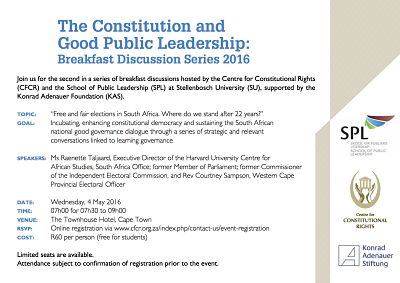 THE CONSTITUTION AND GOOD PUBLIC LEADERSHIP: BREAKFAST DISCUSSION SERIES 2016
 A constitutional crisis occurs when the Constitution is unable to resolve issues that arise within the state or when the actions of state actors – the Executive, the Legislature or the Judiciary – are irreconcilable with the precepts of the Constitution.
 The Centre for Constitutional Rights (CFCR) welcomes the unanimous Constitutional Court decision in the combined cases of Economic Freedom Fighters (EFF) v The Speaker of the National Assembly and Others and Democratic Alliance (DA) v the Speaker of the National Assembly and Others matter. The decision is an emphatic affirmation not only of the Rule of Law, but also the supremacy of the Constitution. The unanimous decision further highlights the importance of the separation of powers in a constitutional democracy, as well as the necessity of checks and balances to protect against the abuse of power. Importantly, the decision has brought clarity as to the binding nature of the Public Protector’s remedial action recommended by her Office.