View Archived Content

ARTICLE: PUBLIC PARTICIPATION IN A DEMOCRATIC SOCIETY: SOUTH AFRICAN VETERINARY ASSOCIATION (SAVA) V SPEAKER OF THE NATIONAL ASSEMBLY
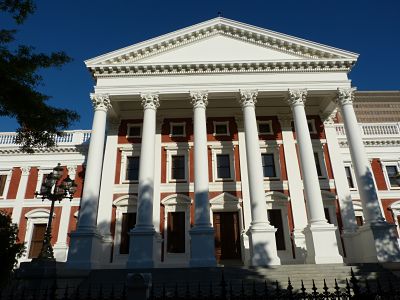
parliament exterior opt

The concept of public participation in South Africa has often been narrowly understood to mean only the participation in public affairs of the State via the right to vote. Whilst the right to vote is indeed an effective tool to ensure public involvement in government affairs, the Constitution also extends public participation to involvement in Parliament’s legislative process. In the Preamble, the Constitution states that South Africa’s democracy should be founded on a government “based on the will of the people”. Further, section 59(1), 72(1) and 118(1) of the Constitution oblige Parliament to “facilitate public involvement in the legislative and other processes” of the same. Parliament may limit the public’s involvement but is prohibited from doing so unless a reasonable and justifiable cause exists. 

Read More »

ARTICLE: PROPOSED AMENDMENTS TO GAUTENG PUBLIC SCHOOL REGULATIONS ERODE TRUST AT THE COST OF ACCESS TO BASIC EDUCATION

TEXTBOOKS

Following the Pretoria High Court judgment in the Overvaal High School (Overvaal) matter and the subsequent violent protests that erupted, it is understandable that little trust exists between School Governing Bodies (SGBs) of public schools and the Gauteng Education Department. In January 2018, the Pretoria High Court found that the Gauteng Education Department arbitrarily instructed Overvaal, a single-medium Afrikaans school, to accept 55 English learners, without first considering the available capacity at surrounding English schools. The Constitutional Court, on the same grounds, refused the Gauteng Education Department’s leave to appeal the Overvaal High Court judgment. 

Read More »

ARTICLE: SABC INQUIRY INTO EDITORIAL INTERFERENCE – OFF TO AN INAUSPICIOUS START

sabc credit sowetanlive opt

At the end of May 2018, the South African Broadcasting Corporation (SABC) Board announced the establishment of a commission of inquiry into editorial interference at the public broadcaster. The inquiry was established in response to various reports of editorial interference over the years and will deal with complaints concerning conduct between 2012 and 2018. The inquiry is part of the ongoing work to transform the SABC into an accountable and responsive public institution, following tumultuous years plagued with unconstitutional editorial policies, and looting at an astronomical level. The Terms of Reference (TOR) of the inquiry acknowledge that the interference could be commercial, political or otherwise driven. The TOR further state that the commission will make recommendations that will lend guidance to the SABC regarding how to address any future interference. Corrective measures – such as disciplinary action where misconduct has been established – are also on the table.

Read More »

CASE DISCUSSION: HIDING BEHIND COOPERATIVE GOVERNANCE – EQUAL EDUCATION AND AMATOLAVILLE PRIMARY SCHOOL V THE MINISTER OF BASIC EDUCATION AND OTHERS

chair school opt

In 2014, the unimaginable death of five-year-old Michael Komape, in a pit latrine at his Limpopo school, revealed the grim reality that South Africa’s education system is failing in the most basic sense. Four years later, five-year-old Lumka Mketwa faced the same horrific death at her Eastern Cape school. These inconceivable deaths must be viewed in light of section 29(1) of the Constitution, which obliges the State unconditionally to ensure that every child has access to a school. Access to a school, confirmed by case law, presupposes access to educational resources and appropriate facilities. How then does one explain this disconnect between reality and the constitutional guarantee supported by a budget allocation proportionally higher than the United Kingdom or Germany? 

Read More »

INVITATION: DISCUSSION – WHITHER ZIMBABWE AFTER THE ELECTIONS?

180821 CFCR KAS SAIFAC INVITE opt

There was much hope for the recent elections in Zimbabwe, particularly since these were the first elections in post-independent Zimbabwe where former President Robert Mugabe was not the presidential candidate for the Zimbabwe African National Union-Patriotic Front (ZANU-PF) political party. In the hotly contested election, current Zimbabwean President, Emmerson Mnangagwa, has been declared the winner of the presidential race, with ZANU-PF gaining more than two-thirds of the seats in Parliament. Amid accusations of rigging, voter intimidation and an uneven playing field, leader of the opposition MDC Alliance, Nelson Chamisa, is at the moment contesting the results on the basis of various electoral irregularities, which served to favour the incumbent. 

What does this mean for Zimbabwe’s so-called new dawn? What effect will the elections have on the economic situation in Zimbabwe? Importantly – can the elections really be deemed to have been “free and fair”. 

Please join the Centre for Constitutional Rights (CFCR) and the South African Institute for Advanced Constitutional, Public, Human Rights and International Law (SAIFAC), a centre of the University of Johannesburg for discussion led by various experts. The event is supported by the Konrad Adenauer Foundation (KAS) and speakers include: Adv Fadzayi Mahere (Law Lecturer, University of Zimbabwe and Independent Parliamentary Candidate), Siphosami Malunga (Open Society Initiative for Southern Africa), Manson Gwanyanya (Researcher, Legal Resources Centre) and Thulasizwe Simelane (Senior Political Journalist, eNCA). 

Read More »

ARTICLE: ACTIVATING AND RENEWING A SENSE OF CIVIC DUTY THIS WOMEN’S DAY

WD2018

South Africa celebrates Women’s Day annually on 9 August to commemorate the more than 20 000 multiracial women, who, on the same day in 1956, marched to the Union Buildings to protest proposed amendments to the Urban Areas Act of 1950 (introducing pass laws for women). In an age before social media, and other modern advancements in communication devices, it is perhaps no exaggeration to describe this gathering as monumental. While it took a further 38 years after the march for all South Africans to finally enjoy equal protection before the law, it remains imperative that the intergenerational activism be carried forward, handed from generation to generation.

Read More »

PUBLICATION: INDEX FOR MEASURING HUMAN RIGHTS IN SOUTH AFRICA

CFCR INDEX FOR MEASURING HUMAN RIGHTS opt

The Centre for Constitutional Rights’ Index for Measuring Human Rights in South Africa was developed to monitor the State’s compliance and observance of certain civil and political rights

The index was produced by  the Centre for Constitutional Rights (CFCR), in cooperation with South African Institute for Advanced Constitutional, Public, Human Rights and International Law (SAIFAC), with project funding supplied by the Mergon Foundation.

Read More »

ARTICLE: ANOTHER FOREIGN POLICY HEADACHE FOR SOUTH AFRICA: INVESTIGATING PRIME MINISTER MODI

BRICS FLAGS opt

South Africa is this week hosting the emerging economies (Brazil, Russia, India, China, South Africa – BRICS) group summit. In the meanwhile, the Muslim Lawyers Association (the Association) has reportedly lodged a complaint with the National Prosecuting Authority (NPA) and further called for the arrest of Indian Prime Minister, Narendra Modi. This, on the basis of a recently released United Nations (UN) report accusing India’s security forces of gross human rights violations in India’s Kashmir province. Suffice to say, the NPA has acquiesced to the request from the Association and announced that the NPA will be investigating Mr Modi for his alleged role in war crimes and human rights violations.

Read More »

INVITATION: IS LOCAL GOVERNMENT THE WEAKEST LINK? SOCIAL JUSTICE, SERVICE DELIVERY AND ACCOUNTABILITY

180814 CFCR Leadership Invite optTHE CONSTITUTION AND GOOD PUBLIC LEADERSHIP: BREAKFAST DISCUSSION SERIES 2018

TOPIC: IS LOCAL GOVERNMENT THE WEAKEST LINK? SOCIAL JUSTICE, SERVICE DELIVERY AND ACCOUNTABILITY

SPEAKER: DR MAKHOSI KHOZA, EXECUTIVE DIRECTOR, OUTA LOCAL GOVERNMENT STRATEGY

Join us for the third in a series of breakfast discussions for 2018 hosted by the Centre for Constitutional Rights (CFCR) and the School of Public Leadership (SPL) at Stellenbosch University (SU) and supported by the Konrad Adenauer Foundation (KAS). 

Read More »