
ARTICLE: THE COMMISSION OF INQUIRY AND NEC CONFIRMATION OF ZUMA’S PRESIDENCY – WHAT DOES 2017 HAVE IN STORE FOR US?
 The deadline for President Zuma to appoint the commission of inquiry as per the Madonsela State Capture Report, came and went quietly at the end of November. Hours before the deadline, the President submitted a court application to review the Madonsela Report and its recommendations. With such an action, the recommendations are temporarily suspended. He and his legal advisors apparently don’t take any chances.
His argument is that her directive is invalid because he, as per the Constitution, did not decide independently to appoint such a Commission and that only he (and not the Chief Justice) can take this action. Mr Zuma further argues that he may not be judge and jury in his own court, as the Commission would have to report to him.
The Constitution does indeed state in section 84(2)(f) that the President is responsible for appointing commissions of inquiry. On the other hand, section 96(2)(b) provides that members of the Cabinet and Deputy Ministers may not “act in any way that is inconsistent with their office, or expose themselves to any situation involving the risk of a conflict between their official responsibilities and their private interests”. Surely that which applies to the Cabinet should also apply to the head of the Cabinet.
ARTICLE: IS SASSA EATING THE POOR?
On 23 November 2016, Parliament’s Standing Committee on Public Accounts (SCOPA) in the National Assembly called the Minister of Social Development, the Auditor-General and members of the Hawks, together with the South African Social Security Agency (SASSA), to a hearing on the weighty matter of irregular, fruitless and wasteful expenditure.
ARTICLE: IS SASSA EATING THE POOR?
 On 23 November 2016, Parliament’s Standing Committee on Public Accounts (SCOPA) in the National Assembly called the Minister of Social Development, the Auditor-General and members of the Hawks, together with the South African Social Security Agency (SASSA), to a hearing on the weighty matter of irregular, fruitless and wasteful expenditure.
A close reading of the minutes of the Committee attest to an Agency befuddled and fiddling while millions of South Africans are drawn deeper into poverty. The patience of the Portfolio Committee was severely tested by playing sleuth in the absence of comprehensive responses and the total absence of institutional accountability, this despite the Committee having provided SASSA with a list of key questions prior to the hearing.
ARTIKEL: INTERNASIONALE DAG TEEN KORRUPSIE: 9 DECEMBER

Die Algemene Vergadering van die Verenigde Nasies het op 31 Oktober 2003 besluit om 9 Desember as Internasionale Dag teen Korrupsie te verklaar. Die rol daarvan is om ‘n bewustheid van korrupsie en van die rol van die VN-konvensie teen Korrupsie te verhoog, wat in 2005 in werking getree het.
Artikel 6 van die Konvensie het van die partye vereis om die bestaan van “’n liggaam of liggame om korrupsie te voorkom” te verseker. Sodanige liggame sal die nodige onafhanklikheid kry om hulle in staat te stel om hul funksies effektief en vry van enige onbehoorlike invloed uit te voer. Hulle sal ook van die “nodige materiële hulpbronne en gespesialiseerde personeel voorsien word, asook die opleiding wat sulke personeel benodig om hul funksies uit te voer”.
ARTICLE: INTERNATIONAL ANTI-CORRUPTION DAY: 9 DECEMBER
On 31 October 2003, the United Nations General Assembly decided to declare 9 December as International Anti-Corruption Day. Its role would be “to raise awareness of corruption and of the role of the UN Convention against Corruption” that came into force in 2005.
Article 6 of the Convention required States Party to ensure the existence of “a body or bodies to prevent corruption”. Such bodies would be granted the necessary independence to enable them to carry out their functions effectively and free from any undue influence. They would also be provided with the “necessary material resources and specialised staff, as well as the training that such staff may require to carry out their functions.”
DISCUSSION SUMMARY: UNPACKING THE NATIONAL HEALTH INSURANCE (NHI) BILL
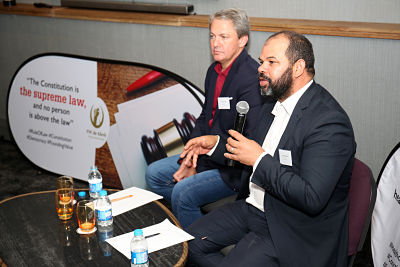
On Thursday 28 November, the Centre for Constitutional Rights (CFCR) and the Konrad Adenauer Foundation (KAS) hosted the final of a series of topical discussions for 2019. The discussion series aims to bring together stakeholders from like-minded institutions, representatives of foreign communities, members of the public at large and any other interested parties, to allow for the sharing of thoughts, opinions and solutions.
The topic was “Unpacking the NHI Bill”. With the deadline for submissions on NHI due on 29 November 2019 the CFCR invited two speakers, Mr Michael Settas, member of the Free Market Foundations’ Health Policy Unit, and Mr Russell Rensburg, Executive Director of the Rural Health Advocacy Project. Speakers shared their thoughts on the proposed NHI and whether this financing system could achieve Universal Health Care (UHC).