
ARTICLE: IS SASSA EATING THE POOR?
On 23 November 2016, Parliament’s Standing Committee on Public Accounts (SCOPA) in the National Assembly called the Minister of Social Development, the Auditor-General and members of the Hawks, together with the South African Social Security Agency (SASSA), to a hearing on the weighty matter of irregular, fruitless and wasteful expenditure.
ARTICLE: IS SASSA EATING THE POOR?
 On 23 November 2016, Parliament’s Standing Committee on Public Accounts (SCOPA) in the National Assembly called the Minister of Social Development, the Auditor-General and members of the Hawks, together with the South African Social Security Agency (SASSA), to a hearing on the weighty matter of irregular, fruitless and wasteful expenditure.
A close reading of the minutes of the Committee attest to an Agency befuddled and fiddling while millions of South Africans are drawn deeper into poverty. The patience of the Portfolio Committee was severely tested by playing sleuth in the absence of comprehensive responses and the total absence of institutional accountability, this despite the Committee having provided SASSA with a list of key questions prior to the hearing.
ARTICLE: DID THE COMMISSION OF INQUIRY ON STATE CAPTURE UNINTENTIONALLY EXTEND JACOB ZUMA’S POLITICAL SHELF LIFE?
 The previous Public Protector’s report on state capture has been released and the political impact of the report and its findings have already been felt, and will be for some time. What happens after the Commission of Inquiry (the Commission) publishes its report, findings and recommendations? What influence will these have on the Zuma presidency and his successors?
The recommendation of the Public Protector is that the President appoints a Commission of Inquiry within 30 days. This must therefore take place by 2 December. For this to happen the President requires the name of the designated Chairman very soon – as identified by Chief Justice Mogoeng. The Commission has 180 days to complete its work.
ARTICLE: INTERNATIONAL ANTI-CORRUPTION DAY: 9 DECEMBER

On 31 October 2003, the United Nations General Assembly decided to declare 9 December as International Anti-Corruption Day. Its role would be “to raise awareness of corruption and of the role of the UN Convention against Corruption” that came into force in 2005.
Article 6 of the Convention required States Party to ensure the existence of “a body or bodies to prevent corruption”. Such bodies would be granted the necessary independence to enable them to carry out their functions effectively and free from any undue influence. They would also be provided with the “necessary material resources and specialised staff, as well as the training that such staff may require to carry out their functions.”
DISCUSSION SUMMARY: UNPACKING THE NATIONAL HEALTH INSURANCE (NHI) BILL
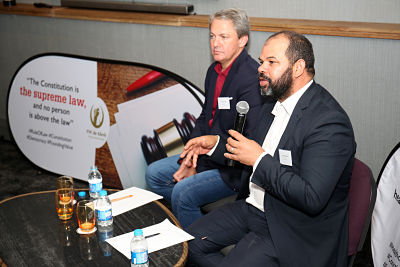
On Thursday 28 November, the Centre for Constitutional Rights (CFCR) and the Konrad Adenauer Foundation (KAS) hosted the final of a series of topical discussions for 2019. The discussion series aims to bring together stakeholders from like-minded institutions, representatives of foreign communities, members of the public at large and any other interested parties, to allow for the sharing of thoughts, opinions and solutions.
The topic was “Unpacking the NHI Bill”. With the deadline for submissions on NHI due on 29 November 2019 the CFCR invited two speakers, Mr Michael Settas, member of the Free Market Foundations’ Health Policy Unit, and Mr Russell Rensburg, Executive Director of the Rural Health Advocacy Project. Speakers shared their thoughts on the proposed NHI and whether this financing system could achieve Universal Health Care (UHC).
STATEMENT: NHI BILL DOES NOT PROVIDE ANSWER TO ACHIEVING UNIVERSAL HEALTH COVERAGE

On 29 November 2019, the FW de Klerk Foundation (the Foundation) made a written submission on the National Health Insurance Bill [B11-2019] (NHI Bill) to the Portfolio Committee on Health. The NHI Bill envisions the establishment of the NHI Fund – a health financing system serving as the “single purchaser and payer of health care services”, – to effectively achieve Universal Health Coverage (UHC) and give effect to the State’s constitutional duty to provide access to healthcare services.
The Foundation unequivocally supports the pursuit of UHC – characterised by the World Health Organisation (WHO) as providing all people with access to health services of sufficient quality, without financial hardship. The Foundation, however, does not believe that the proposed NHI is the only means to achieve this noble goal for South Africa.