
INVITATION: THE CONSTITUTION, GOOD PUBLIC LEADERSHIP AND SOUTH AFRICAN INTERNATIONAL RELATIONS
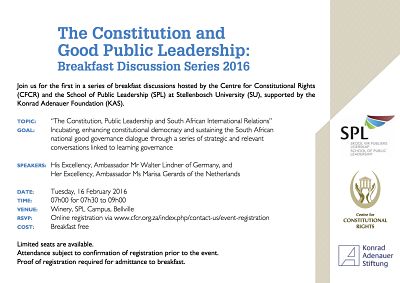 THE CONSTITUTION AND GOOD PUBLIC LEADERSHIP: BREAKFAST DISCUSSION SERIES 2016
TOPIC: THE CONSTITUTION, GOOD PUBLIC LEADERSHIP AND SOUTH AFRICAN INTERNATIONAL RELATIONS
SPEAKERS: HIS EXCELLENCY, AMBASSADOR MR WALTER LINDER OF GERMANY, AND HER EXCELLENCY, AMBASSADOR MS MARISA GERARDS OF THE NETHERLANDS
 The uThukela District Municipality (the Municipality) in KwaZulu-Natal Province has established a “Maidens Bursary” to fund higher education for young women. That is laudable. But, that is not all. Sixteen young women who are the beneficiaries of the scholarship, are reportedly examined regularly to ascertain their virginity. The bursary is conditioned upon their remaining virgins. This, happening in 2016, in a supposedly constitutional democracy.
 The Centre for Constitutional Rights (the CFCR) wishes all its friends and supporters peace and happiness during the Festive Season and good health and prosperity for the New Year …
 Corruption has many guises. It includes bribing of public officials, public officials trading in influence or abusing their functions of power for personal gain, illicit enrichment and embezzlement, misappropriation or diversion of property by a public official. Of course, corruption is not limited to public administration. Nevertheless, corruption in public administration is particularly damaging to democratic institutions, the economy and the Rule of Law.
 On 3 December 2015 the Centre for Constitutional Rights (CFCR) and the School of Public Leadership (SPL) at Stellenbosch University (SU), supported by the Konrad Adenauer Stiftung (KAS), hosted the fifth and final in a series of breakfast discussions for 2015. The aim of these discussions is to create a platform for conversation and debate about the Constitution and good public leadership. This discussion focused on the future of higher education in the country in the wake of two nationwide protests championed by students regarding transformation at these institutions, as well the raising of tuition fees at the same. The breakfast was attended by guests from across the spectrum including government, academia, civil society and the media.
 3 December annually is set aside by the United Nations as the International Day of Persons with Disabilities. The day is meant to promote awareness and mobilise support for critical issues relating to the inclusion of persons with disabilities in society and development. The day seeks to further promote action to raise awareness about disability issues and draw attention to the benefits of an inclusive and accessible society for all. This years’ theme ‘Inclusion Matters: Access and Empowerment for People of all Abilities’ focuses on accessibility and disability in the context of urban development.
 The recent ruling of the Constitutional Court in the Mtyhopo v South African Municipal Workers Union National Provident Fund, to set aside the decision of the Grahamstown High Court is welcomed. The decision emphasises the constitutionally-protected right to the freedom of expression. This right is enshrined in section 16 of the Constitution. The case concerns disgruntled members of the Municipal Workers Union National Provident Fund (the Fund) in the Eastern Cape and the manner in which the Fund attempted to infringe the right of the applicant to voice his grievances in relation to the Fund.
 A recent ruling of the Constitutional Court (the Court) in the Oppelt v Head: Health, Department of Health, Provincial Administration: Western Cape saw a decision of the Supreme Court of Appeal (SCA) set aside. The Court found that the Department of Health (the Department) was indeed liable to pay damages to Mr Oppelt (the Applicant) after a sporting accident which resulted in the Applicant being left quadriplegic.
  The recent judgment by the Supreme Court of Appeal (SCA) in De Villiers v S to set aside the decision of the High Court and reduce the sentence of Mrs De Villiers is a victory for children’s rights and echoes precedent that dictates that where a child will be affected by the incarceration of a parent/ caregiver, heavy consideration must be afforded to the best interests of that child. Considering the importance of children’s rights, it is necessary to reflect on the thinking of the Court in handing down this decision.