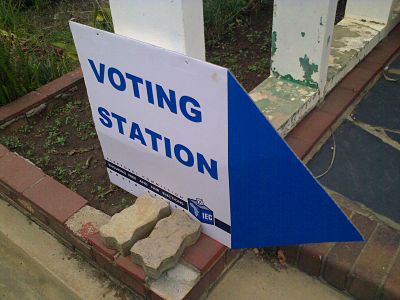
 On Wednesday, 3 August, South Africans will cast their votes in the nation’s fourth democratic local government elections. Political rights are enshrined in the Bill of Rights, while the nation’s founding values include “universal adult suffrage, a national common voter’s roll, regular elections and a multi-party system of democratic government to ensure accountability, responsiveness and openness”.
The reported incidents of election-related violence and destruction of property cast doubt as to the degree with which the local government elections can be said to be free and fair. Already, the South African Human Rights Commission (SAHRC) has reported that in the run-up to the August 3 elections, there have been about 50 politically-related killings, predominantly in KwaZulu-Natal and Mpumalanga. The Institute for Security Studies (ISS), in a similar vein, notes that political killings are as a result of local conflicts and rivalries.

 On Friday, 26 August 2016, the FW de Klerk Foundation is hosting a conference in Johannesburg to launch its Centre for Unity in Diversity (CUD). The Centre’s name is derived from the reference in the Preamble to the Constitution that South Africa belongs to all who live in it, united in our diversity.
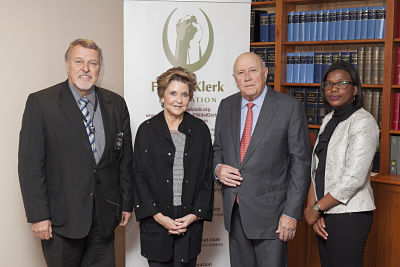 The FW de Klerk Foundation is delighted to be able to contribute R529 650 towards the work of the National Institute for the Deaf (NID). On Friday, 12 August, the Foundation hosted a handover ceremony with former President FW de Klerk and Mr Deon de Villiers (head of the NID) at the Foundation’s offices.
 The renaming of streets and places must be handled with the greatest sensitivity. All South Africans should feel that they and their cultures are fully represented in street and place names. The Constitution declares that South Africa belongs to us all, united in our diversity.
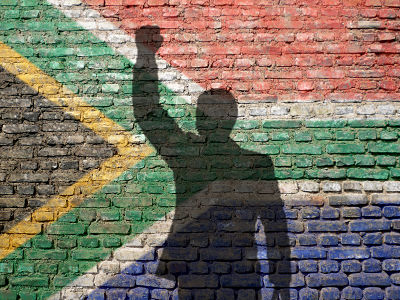 Mandela Day provides an opportunity to acknowledge and celebrate the life and service of former President Nelson Mandela. In keeping with the call to ‘take action’ and help change lives for the better, staff of the FW de Klerk Foundation and its Centre for Constitutional Rights (CFCR) will donate their time to two very worthy organisations. Staff will participate in hands-on projects at Autism Western Cape, and Iris House Children’s Hospice – organisations that make a meaningful, daily difference in the lives of children with disabilities.
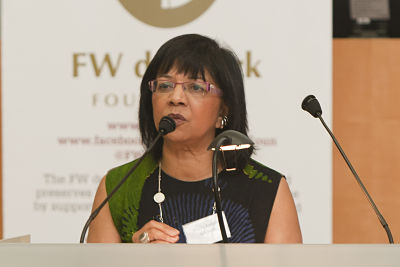 The FW de Klerk Foundation is pleased to announce the appointment of Ms Rhoda Kadalie as Deputy Chairperson of its Board of Trustees. Ms Kadalie, who joined the Board in October 2014, was unanimously elected as the Board’s Deputy Chairperson at a Board meeting held on 11 July 2016. With her extensive experience as an academic, as well as her ongoing work related to the advancement of human rights and the achievement of equality, the Board believes Ms Kadalie will add great value to the work of the Foundation.
 The medical profession is amongst the most altruistic of career paths. There is a commonplace understanding that becoming a doctor involves dedicating one’s life to the passion for saving the lives of others. The true extent of the dedication required is however a lesser known reality. Public health care practitioners face rigorous working hours rendered unlawfully exploitive in most other sectors. Young medical graduates bear the bulk of this burden, obliged to deal with these despotic working conditions in their two-year internship and further year of mandatory community service in order to complete their qualification.
 The University of Pretoria’s (UP) new language policy does not pass constitutional muster and leaves the university open to legal challenges.