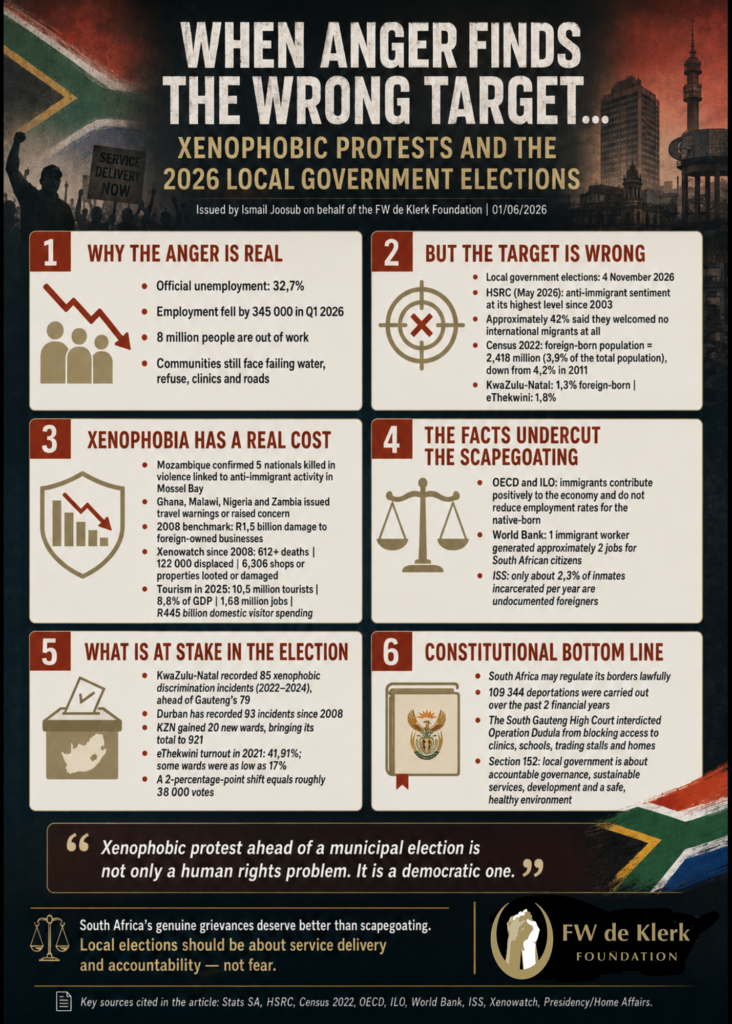
South Africa is heading into a municipal election with real grievances and the wrong argument. Official unemployment stands at 32,7%. Employment fell by 345 000 in the first quarter of 2026 alone. Eight million people are out of work. Local services – water, refuse, clinics, roads – remain unreliable in the very communities where people feel those failures most personally. The anger on the streets is not manufactured. It is earned. The problem is where it is being directed.
Between April and May 2026, the movement March and March organised demonstrations in Pretoria, Johannesburg and Durban that turned violent and, in some instances, fatal. On 29 April, the Johannesburg march forced the closure of shops owned by both South Africans and migrants, as residents braced for looting. By 2 June, Mozambique had confirmed that five of its nationals died in violence linked to anti-immigrant activity in Mossel Bay and citizens were already returning home. Ghana, Malawi, Nigeria and Zambia have all issued travel warnings or formally expressed concern at the African Union. A domestic political episode has become a foreign policy incident. A protest movement has become a national liability.
The political timing matters enormously. President Ramaphosa has set 4 November 2026 as the date for local government elections and voter registration weekends are already underway. The protest wave is not arriving after an election. It is arriving inside one, shaping campaign language, voter anxieties and party calculations before a single ballot has been cast.
The HSRC reported in May 2026 that anti-immigrant sentiment has reached its highest recorded level since the survey series began in 2003. Approximately 42% of respondents said they welcomed no international migrants at all. That sentiment is concentrated in KwaZulu-Natal, Gauteng, Mpumalanga and Limpopo – precisely the provinces most contested in local elections. KwaZulu-Natal is now the country’s leading province for documented xenophobic discrimination incidents, recording 85 between 2022 and 2024, ahead of Gauteng’s 79. Durban alone has accumulated 93 recorded incidents since 2008. This is not a new temperature spike. It is the latest peak of a long, recurring pattern, happening in a province where the Municipal Demarcation Board has just added 20 new wards – bringing KZN’s total to 921, the biggest provincial increase nationally – creating more electoral contests and more opportunities for candidates to position themselves around fear.
Against this charged atmosphere, the actual demographic picture is striking for its modesty. Stats SA’s Census 2022 counted 2,418 million foreign-born persons in South Africa, representing 3,9% of the total population, down from 4,2% in 2011. In KwaZulu-Natal, 1,3% of the provincial population was born outside South Africa; in eThekwini, 1,8%. The political temperature is vastly out of proportion to the demographic scale and that mismatch tells you something important: the immigration issue is functioning symbolically. It is a vessel into which diffuse dissatisfaction with failing institutions has been poured and migrants are the convenient occupants of a space that should, constitutionally, be occupied by questions of governance.
The economic case against scapegoating is no less emphatic. The OECD and ILO both conclude that immigrants contribute positively to South Africa’s economy, do not reduce employment rates for the native-born and make a net positive contribution to the fiscal balance. World Bank research found that one immigrant worker generated approximately two jobs for South African citizens. ISS analysis shows that only about 2,3% of inmates incarcerated per year are undocumented foreigners – directly contradicting the routine claim that migrants drive crime. The R1,5 billion estimated in damage to foreign-owned businesses during the 2008 xenophobic violence offers a sobering benchmark for what the current wave could cost and Xenowatch’s cumulative record since 2008 runs to over 612 deaths, 122 000 people displaced and 6,306 shops or properties looted or damaged.
These are not abstract moral statistics. They are a record of destroyed livelihoods. And, the tourism dimension adds further exposure in that South Africa welcomed 10,5 million tourists in 2025, with the sector contributing roughly 8,8% of GDP, supporting 1,68 million jobs and generating R445 billion in domestic visitor spending. Anti-immigrant violence filmed and formally protested by five neighbouring governments is already testing the regional reputation on which much of that economy depends.
The FW de Klerk Foundation holds a clear and principled position on the constitutional question. South Africa has the sovereign right to regulate its borders and remove unlawful entrants through authorised channels. The Presidency has been explicit on this and Home Affairs has backed it with action: 109 344 deportations were carried out over the past two financial years combined. The state is not ignoring unlawful immigration. That enforcement record is, in fact, the most devastating rebuttal available to vigilantism. If the state is already acting through lawful means, there is no constitutional justification for movements that appoint themselves immigration authorities. The South Gauteng High Court has already drawn this line, interdicting Operation Dudula from blocking access to clinics, schools, trading stalls and homes. The court confirmed what the Constitution has always said: enforcement belongs to the state, not the street.
What is constitutionally at stake in the 2026 elections is not simply public order. It is the integrity of what local democracy is supposed to be about. Section 152 of the Constitution defines the objects of local government as accountable governance, sustainable services, social and economic development and a safe and healthy environment. Municipal elections should be a competition over institutional competence – over who can fix the water, manage informal trading fairly, staff the clinics and hold officials to account. Once xenophobic mobilisation dominates, that competition collapses into a race to perform hostility toward outsiders as a substitute for administrative capacity. Candidates begin promising what municipalities have no legal authority to deliver and voters are encouraged to measure success by toughness toward foreigners rather than service delivery outcomes.
The 2021 local election turnout in eThekwini was 41,91%, with some wards falling as low as 17%. In that environment, a two-percentage-point shift represents roughly 38 000 votes – enough to change multiple ward outcomes. The danger is not that fringe movements take office. It is that larger parties absorb their language, ward candidates campaign as neighbourhood protectors against foreign pressure and municipal accountability is quietly replaced by identity performance. The ISS has noted that the 2008 violence, which killed 62 people and displaced more than 200 000, was understood to have been fuelled at least partly by political rhetoric ahead of the 2009 election. The 2026 cycle is producing its own version of that pattern, earlier and more broadly than before.
The Foundation’s argument can simply be summed up that xenophobic protest in the run-up to a municipal election is not only a human rights problem. It is a democratic one. It converts constitutionally directed accountability – the kind that demands better local government from elected officials – into unconstitutional scapegoating of a vulnerable minority. It offers the appearance of action while guaranteeing worse outcomes: closed shops, economic contraction, diplomatic damage, tourism risk and elections decided on fear rather than competence.
South Africa’s genuine grievances deserve better than this. Its constitutional order demands it.
For more on this topic read: FW DE KLERK FOUNDATION EXPRESSES CONCERN OVER RISING XENOPHOBIC MOBILISATION – https://fwdeklerk.org/fw-de-klerk-foundation-expresses-concern-over-rising-xenophobic-mobilisation/