Introduction
Many South Africans face a difficult journey before they can even enter a courtroom. They travel long distances, spend money they can hardly afford on transport, and often wait months or even years before their cases are heard. For many people, access to justice remains out of reach despite the Constitution guaranteeing everyone the right to have their disputes decided by a court.
Cabinet has now approved the report of the Committee on the Rationalisation of Areas under the Jurisdiction of the Divisions of the High Court of South Africa and Judicial Establishments (“the Rationalisation Committee”). The court rationalisations aim to reshape South Africa’s court system by bringing courts closer to communities, reducing delays and improving access to justice.
These reforms are about more than changing court boundaries or building new court facilities. They are about making constitutional rights meaningful in everyday life. A constitutional right to have your disputes decided by a court has little value if people cannot afford to reach a court, or must wait years before their case is heard.
Why are South Africa’s courts being rationalised?
South Africa’s court system does not always serve people equally. Many communities, especially those in rural areas and former-homeland regions, still live far from a High Court. Reaching a court can involve long journeys, high transport costs and time away from work or family responsibilities. These challenges make it harder for many people to enforce their rights.
The Rationalisation Committee was established in 2021. Its task was to look at parts of the High Court system that needed to change so that the courts could better meet the requirements of the Constitution. The Committee completed its work in two phases. The first phase dealt with the areas over which the main and local seats of the High Court divisions should exercise jurisdiction. It also recommends the creation of additional High Court seats. The second phase looked at the number and addition of judges across the High Court divisions. It recommended a 20% increase in the judicial appointments across the divisions.
This is closely linked to section 34 of the Constitution. Section 34 guarantees everyone the right to have any dispute that can be resolved by the application of law decided in a fair public hearing before a court or another independent and impartial tribunal or forum (“access to justice”). This right can only be fully realised when courts are reasonably accessible. Bringing courts closer to communities is, therefore, not simply an administrative exercise. It is a practical way of giving effect to a constitutional right.
The Importance of Access to Justice
Access to justice means that people can use the courts when they need them. It allows people to enforce their rights, challenge unlawful decisions and resolve disputes through the law.
The Constitutional Court has repeatedly recognised the importance of this right. In Chief Lesapo v North West Agricultural Bank, the Court described access to courts as “foundational to the stability of an orderly society“. Courts allow people access to justice distributed by the state, instead of people taking the law into their own hands. The Court also recognised that access to courts is vitally important to the rule of law.
Bringing courts closer to communities could strengthen society and the rule of law. People who previously struggled to reach a court may find it easier and less expensive to pursue their cases. It could also help build confidence in a justice system that is accessible to the people it is meant to serve.
Justice delayed can become justice denied
Making courts easier to reach is only part of the solution. Justice must also be delivered without unnecessary delay. A court system that takes years to resolve cases can undermine confidence in the law and make it harder for people to enforce their rights.
Court delays affect people in different ways. Victims of crime may wait years for justice. Accused persons may spend long periods waiting for their trials to begin. Families involved in maintenance, divorce or childcare disputes can remain in uncertainty. Businesses may also struggle to make important decisions when commercial disputes remain unresolved for years.
The pressure on the Gauteng High Court shows how serious the problem can become: In 2025, the earliest available dates for new civil trials in the Gauteng Division had stretched as far as 2031. The Gauteng Division is the country’s busiest High Court division and handles a large share of South Africa’s civil litigation.
The problem is not only the number of cases. Many matters placed on the civil trial roll did not have to go to trial. An analysis of cases enrolled during three weeks in March 2025 found that only 11 of 339 matters on the Pretoria civil trial roll required judicial attention. Many other matters were settled, or could be resolved without a judge.
The situation led Gauteng Judge President Dunstan Mlambo to introduce mandatory mediation for civil trial matters in April 2025. Under the new system, new civil matters must first go through mediation before receiving a trial date. The aim is to keep cases that can be settled out of the courtroom and free judges to deal with disputes that genuinely require a court decision.
Additionally, the shortage of judges adds to the pressure. The number of judges allocated to the Gauteng Division had not increased since 2008, even though its caseload has continued to grow. Apart from the 20% increase in judicial appointments mentioned above, the Rationalisation Committee also recommended reviewing the guidelines for appointing acting judges.
At the time of writing, the government has started working with the National Treasury and the Office of the Chief Justice to give effect to this recommendation.
More judges could ease some of the pressure, but appointments alone will not solve every problem. Courts also need enough courtrooms, administrative staff and effective case management systems.
Bringing the High Court closer to communities
The first phase of the rationalisation process also recommended additional local High Court seats. These include Palm Ridge in Gauteng, Welkom in the Free State, Rustenburg in the North West, Upington in the Northern Cape and Thembalethu in the Western Cape. Government plans to put these recommendations into effect in phases. Where suitable court infrastructure already exists, it can be used. Other local seats may require new courts or the expansion of existing magistrates’ courts.
These changes could make a real difference to communities that have historically been underserved. People may no longer need to travel as far to access High Court services. This could reduce transport costs, save time and make it easier for people to pursue legal remedies.
Conclusion
Court rationalisation could make justice easier to reach and help reduce delays. But its success will depend on proper funding, enough staff and effective implementation. Ultimately, the test is simple: can people reach courts when they need them? Can their cases be heard without unreasonable delay? Can they rely on the courts to protect their rights? And can they obtain an effective remedy when their rights are violated? If the answer is yes, rationalisation will assist to turn the constitutional right of access to justice into a reality.
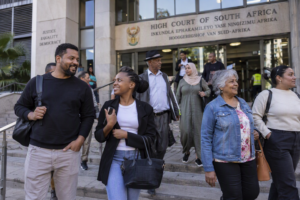
Image generated using Microsoft Copilot AI and curated by FW de Klerk Foundation