
ARTICLE: WHERE TO FROM HERE FOR THE NATIONAL PROSECUTING AUTHORITY ON JIBA AND MRWEBI?
 It is a convoluted affair and – where sense can be made of it – suggests an organisation mired in skulduggery and maladministration. That since its inception the National Prosecuting Authority (NPA) is yet to have a head successfully complete a full term without either resigning or being forced to leave the position, is one of the telling signs.
The latest blight to the prosecuting body is the recent decision by the North Gauteng High Court (the Court) in which the General Council of the Bar sought, successfully, to have Nomgcobo Jiba (Jiba) and Lawrence Mrwebi (Mrwebi) struck off the Roll of Advocates. In the judgment, the Court made damning findings against the two. It is of great concern that the following was said of individuals at the helm of the nation’s crime fighting organisation: “I cannot believe that two officers of the court (advocates) who hold such high positions in the prosecuting authority will stoop so low for the protection and defence of one individual who had been implicated in the serious offences.”
 The embattled Chief Operations Officer (COO) of the South African Broadcasting Cooperation (SABC) may have reached the end of his tenure at the public broadcaster. After a series of court battles with opposition parties, the Supreme Court of Appeal (SCA) has dismissed SABC COO, Hlaudi Motsoeneng’s application for leave to appeal a High Court ruling that his permanent appointment should be set aside.
 An ad hoc committee was established by Parliament to oversee the appointment of the successor to the Public Protector, Advocate Thuli Madonsela. It was chaired by the African National Congress (ANC) MP, Dr Makhosi Khoza. In her opening speech she promised “the best person for the job”. Serving in the committee, were Julius Malema on behalf of the Economic Freedom Fighters (EFF), together with the following: Glynnis Breytenbach, Phumzile van Damme, James Selfe and Werner Horne, on behalf of the Democratic Alliance (DA). Other members included on behalf of the ANC, besides the chairperson, Makhosi Khoza, Bongani Bongo, Amos Masondo, Nicolaas Koornhof, Grace Tseke, Madipoane Mothapo, and Patrick Maesela.
 Yesterday, the Constitutional Court (the Court) in Nkabinde and Another v Judicial Service Commission and Others, ruled that a provision in the Judicial Service Commission Act meets constitutional muster. In making the ruling, the Court dismissed the application filed by Justices Nkabinde and Jafta to rescind an order previously made by the same Court. The Court further underlined that it is in the interests of justice that the complaint against Western Cape Judge President Hlophe be brought to finality.
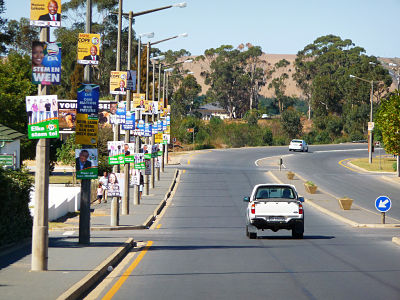 In the months leading up to this year’s Local Government Elections, the possibility of free and fair elections was marred by various incidents across the country. From protests in Vuwani regarding municipal demarcation, to the multiple political killings in KwaZulu-Natal, as well as the plethora of objections and complaints on election day, it was indeed unlikely that a calm political atmosphere would prevail following the release of the final results. However, after the conclusion of the voting process and the announcement of the final results, the Independent Electoral Commission (IEC) declared the elections free and fair. These sentiments have been echoed by the Law Society of South Africa.
 Pockets in the City of Tshwane are beset by violence, with media reports showing burnt-out shells of motor vehicles, and streets littered with burning tyres. One person is said to have been killed in the violence. The violent protests are ostensibly as a result of party members’ unhappiness with the governing party’s National Executive Council’s decision to select a mayoral candidate ahead of the candidates preferred by the Tshwane branch of the governing party.
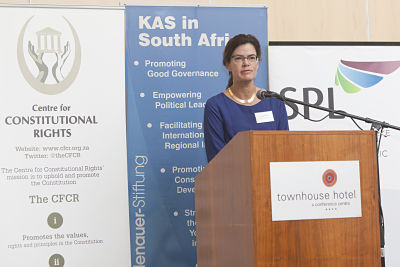 On 4 May 2016 the Centre for Constitutional Rights (CFCR) and the School of Public Leadership (SPL) at Stellenbosch University (SU), supported by the Konrad Adenauer Stiftung (KAS), hosted the second in a series of breakfast discussions for 2016. The aim of these discussions is to create a platform for conversation and debate about the Constitution and good public leadership.
 In March 2010 the Centre for Constitutional Rights (CFCR), in line with its mission to uphold and defend the Constitution, submitted a complaint to the South African Human Rights Commission (SAHRC) on behalf of Mr Chumani Maxwele. The SAHRC has a constitutional mandate to protect, promote and monitor human rights in South Africa. The SAHRC is further empowered by the South African Human Rights Commission Act to investigate and report on the observance of human rights in the country and to take steps to secure the appropriate redress where human rights have been violated. The complaint concerned the abuse of Mr Maxwele by members of the President’s Special Protection Unit and in so doing, the violation of his constitutional rights. The President’s Special Protection Unit accused Mr Maxwele of making an obscene gesture at the President’s motorcade as it drove past him in Cape Town. Following which, the same Unit arrested and bundled him into one of the vehicles, after he was restrained and blinded using a black bag. He was detained overnight and was interrogated, all the while denying having made the gesture in question.