
STATEMENT: THIS INTERNATIONAL HUMAN RIGHTS DAY: REMEMBERING THE MOST VULNERABLE
 The Centre for Constitutional Rights (CFCR) celebrates international Human Rights Day but also calls for the protection of society’s more vulnerable groups.
Noluvo Swelindawo lived openly as lesbian in Khayelitsha until she was brutally murdered – supposedly, because of her sexual orientation – joining a growing list of such horrific incidents in South Africa. Despite the fact that the Constitution prohibits unfair discrimination on grounds including ‘sexual orientation’ – and further that the State is obliged to respect, protect, promote and fulfil the rights in the Bill of Rights – there are simply too many reported incidents of such intolerance. The proliferation of such attacks occurs despite the observance of international Human Rights Day, which day also marks the end of the 16 Days of Activism against Gender-Based Violence Campaign.
South Africa already suffers one of the highest rates of rape in the world – and with women such as Noluvo Swelindawo, their sexual identity adds an extra layer of vulnerability. The 16 Days of Activism against Gender-Based Violence Campaign is meant to address gender-based violence, including the type of violence directed against women who identify as lesbian, gay, bisexual or transgender.
 On 1 December 2016, we celebrate World AIDS Day – the global initiative which aims to unite people in the fight against the disease. In the spirit of the day it is perhaps appropriate to take a moment and reflect on the significant advancements made during this year by various role players in the fight against HIV and AIDS.
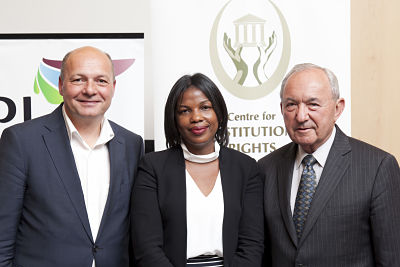 On 30 November 2016, the Centre for Constitutional Rights (CFCR) and the School of Public Leadership (SPL) at Stellenbosch University (SU), supported by the Konrad Adenauer Stiftung (KAS), hosted the final dialogue in a series of discussions for 2016. The discussions aim to create a platform for debate and dialogue about the Constitution and good public leadership.
 Parliament’s Joint Standing Committee on Intelligence (JSCI) has finally nominated a candidate for the post of Inspector-General of Intelligence (IGI) after the post had been vacant since 31 March 2015. Dr S.I. Dintwe has been nominated as the preferred candidate by the JSCI, and the National Assembly (NA) will vote on the nomination this week. The election process has not been without setbacks but public participation and civil action ensured a more open and transparent process this time around, which appears to be the pattern for ensuring accountability in 2016. Despite serious attacks on our constitutional democracy this year, the founding values of “accountability, responsiveness and openness” are alive and well and being upheld by ordinary South Africans through action by civil society – a proud moment for the Constitution.
 The period from 25 November (International Day for the Elimination of Violence against Women), to 10 December (International Human Rights Day), marks the annual commemoration of the 16 Days of Activism against Gender-Based Violence campaign. The international campaign originated from the first Women’s Global Leadership Institute coordinated by the Center for Women’s Global Leadership in 1991. Annually, United Nations Women spearhead this cause and this year’s theme is centered around resources that are needed to facilitate the cessation of gender-based violence across the world.
 On 20 November, Universal Children’s Day will be celebrated around the world. This day is dedicated to promoting the welfare of children and signifies the adoption of the Declaration of the Rights of the Child and the Convention on the Rights of the Child by the United Nations (UN). In South Africa, this is a day dedicated to the 19.7 million children under the age of 18 around the country.
  The leader of South Africa’s third largest political party, Mr Julius Malema, finds himself in the crosshairs of the law once again. This time, for allegedly contravening the Riotous Assemblies Act in purportedly urging his supporters to invade land. He is reported to have said this to a large group of supporters in 2014, and mostly recently, in June 2016. News reports further mention his intention to approach the Constitutional Court to challenge the constitutionality of the Riotous Assemblies Act. Various political commentators appear to be in agreement with this assertion, premised on the fact that the Riotous Assemblies Act (the Act) pre-dates the Constitution as it was promulgated in 1956.
 On 11 November 2016, Communications Officer Megan Dick, and CFCR interns, Kiah Murphy and Sonam Mansingh had the opportunity to visit the soon-to-be-completed Welvanpas Water Treatment Works purification plant in Drakenstein Municipality.
  In a unanimous judgment delivered by the Chief Justice Mogoeng, the Constitutional Court reinforced the founding values of our Constitution, which is built on human dignity and the achievement of a non-racial South Africa. This judgment sends a clear message to all employers and employees that racism will not and cannot be condoned in the workplace.