Introduction
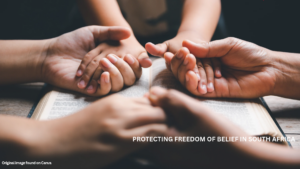
South Africa is home to people of many faiths. Churches, mosques, synagogues, temples and other places of worship are part of everyday life. The Constitution protects this diversity. Section 15 of the Constitution protects freedom of conscience, religion, thought, belief and opinion. This means that people are free to hold their own religious beliefs. They may also practise their religion. It also protects people who have no religion.
The Constitution also explicitly allows religious observances at state and state-aided institutions. These observances must follow the rules of the institution. They must be conducted on an equitable basis. Attendance must also be free and voluntary.
Religious communities, as opposed to simply individuals, are also protected under section 31. This section explicitly prohibits denying members of a religious community the right to practise their religion (or from forming and maintaining religious associations) in line with the Bill of Rights.
A Debate About Self-Regulation
One of the main issues identified in the FW de Klerk Foundation’s Cultural, Religious, and Linguistic Rights Report Card 2026 (“CRL Report Card”) was the proposed self-regulation of the religious sector. In October 2025, the CRL Rights Commission established a Section 22 Ad Hoc Committee for the Christian sector (“the Section 22 Committee”). As per the Section 22 Committee’s Terms of Reference, it was to focus on the Christian sector. It was also tasked with helping to develop a legal framework for the registration of religious institutions and practitioners. The framework would also include a code of conduct and ethics for religious practitioners.
In December 2025, the Section 22 Committee published a Draft Self-Regulatory Framework for the Christian Sector for national consultation. The framework was presented as a voluntary initiative by the Christian sector and was described by the Section 22 Committee as a voluntary, sector-led initiative rather than State regulation. The draft framework sets standards for governance and ethical conduct. It also proposes an independent Christian Practice Council for Ethics and Accountability (“CPCEA”). The CPCEA would support organisations that choose to follow the framework. It would also give a “Seal of Good Standing” to organisations that meet its standards.
Of particular note is that the Section 22 Committee’s Chairperson, Reverend Professor Musa Xulu, resigned with immediate effect on 15 January 2026, citing, among other things, that he “can no longer serve as Chair of a Committee … which is being used as a front to disguise a predetermined agenda of State control of religion…”. Xulu also expressed concern about his inability to oversee the Section 22 Committee’s processes and stated that he could not endorse their outcomes. He furthermore raised concerns about the exclusion of significant Christian constituencies and the way the draft framework was being developed.
The process has also been contested outside the Section 22 Committee, with some groups raising concerns about the role of the State and the CRL Rights Commission. Others challenged the process the Section 22 Committee followed. And still others instituted court applications.
The concerns also reached Parliament. At the end of 2025, the South African Church Defenders (“SACD”) marched to Parliament and submitted a memorandum calling for an investigation into the Section 22 process. In the beginning of 2026, the Portfolio Committee on Cooperative Governance and Traditional Affairs (“COGTA Portfolio Committee”) met with religious leaders about the concerns. By April 2026, the Committee also engaged with the CRL Rights Commission about its 2026/27 Annual Performance Plan. And in August 2026, the COGTA Portfolio Committee directed the CRL Rights Commission and its Section 22 Committee to submit a plan to address concerns about inclusivity and reform. It also stated that the religious sector, rather than the CRL Rights Commission, should lead the development of the ethical code.
Conclusion
The CRL Report Card gives freedom of conscience, religion, thought, belief and opinion a C- for 2026. This means that the enjoyment of this right is rated as moderate, with signs of decline. The grade highlights an important point: a right may be protected by the Constitution, yet still face challenges in practice.
The debate surrounding the CRL Rights Commission’s Section 22 process demonstrates the need for constant vigilance in protecting South Africa’s constitutional freedoms. While efforts to promote accountability and ethical conduct within the religious sector may be legitimate, such efforts must never unreasonably or unjustifiably infringe constitutional rights or create (even the perception of) State control over matters of faith. In a diverse constitutional democracy, freedom of religion includes the freedom of religious communities to govern their own affairs, subject only to the Constitution and the law.
As South Africa continues this important conversation, all stakeholders should remain committed to the principles of openness, inclusivity and constitutional compliance. Protecting freedom of belief requires more than legal guarantees. It requires a continued respect for diversity, meaningful engagement with affected communities and a clear commitment to ensuring that both individual believers and religious communities can exercise their rights freely and without undue interference.