Introduction
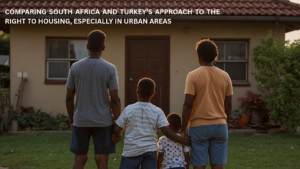
The right to have access to adequate housing is constitutionally entrenched in South Africa. Yet, finding safe and affordable housing has become a challenge around the world. This is especially true as more people are moving to urban areas in search of jobs, education and better opportunities. As cities grow, the demand for housing continues to increase. At the same time, the cost of urban housing continues to rise across South Africa’s metropoles. Many families struggle to find a decent place to live and face eviction. The UN-Habitat World Cities Report 2026 states that globally, there is an affordable housing crisis.
International law and housing
Housing is about more than having a roof over your head. A safe and secure home gives people stability. It supports their health, family life and access to work, schools and other essential services. For this reason, international law recognises housing as a basic human right. Article 25 of the Universal Declaration of Human Rights and Article 11 of the International Covenant on Economic, Social and Cultural Rights both recognise the right to adequate housing. These instruments emphasise that housing must be planned in a way that allows people to live with dignity and participate fully in society.
Although many countries recognise the right to housing, they do not all protect or provide it in the same way. Some place greater emphasis on protecting individual rights, while others focus on planning and development. This article compares South Africa and Turkey to show how these different approaches affect people living in cities. It also looks at what South African can learn from Turkey’s housing policies while continuing to protect the rights of its people.
South Africa
During apartheid, laws such as the Group Areas Act, 1966, forced many Black, Coloured and Asian South Africans out of well-located areas. When democracy began in 1994, the Constitution recognised that access to housing was essential to and explicitly prohibits evictions without a court order or laws that permit arbitrary evictions.
Section 26 of the Constitution says everyone has the right to access adequate housing. It also says the government must take reasonable steps, using the resources that it has, to help more people gain access to housing over time. This means that housing is more than just a government policy. It is a justiciable constitutional right that people can ask the courts to protect.
The Constitutional Court has also played an important role in protecting this right. In Government of the Republic of South Africa v Grootboom, the Constitutional Court found that the government’s housing programme did not do enough to help people who were living in desperate conditions. It ruled that housing policies must also provide for people who are living in desperate conditions. It ruled that housing policies must also provide for people in urgent need, including those living in informal settlements.
The Court reinforced its approach in City of Johannesburg Metropolitan Municipality v Blue Moonlight Properties (Pty) Ltd. It ruled that municipalities must provide emergency housing not only for homeless people, but also for people who are being evicted from private property. The Court also said that governments must plan and budget properly so that more people can gain access to decent housing over time.
The court decisions have shaped the way government approaches housing. Today South Africa uses several programmes to improve access to housing. These include Reconstruction and Development Programme (“RDP”) houses for low-income households, the First Home Finance (“FHF”) programme, formally known as the Financed Linked Individual Subsidy Programme (“FLISP”) and programmes that upgrade informal settlements by improving roads, water, sanitation and electricity. Government also provides temporary housing for people who lose their homes because of evictions, fires, floods or other disasters.
These programmes have helped millions of South Africans since 1994. However, the demand for housing continues to grow faster than new homes can be built. Many people still live in informal settlements without reliable basic services. Others remain on housing waiting lists for many years. Rapid urbanisation, limited public funding, rising building costs and delays in housing projects have made it difficult for governments to keep up with demand.
Despite these challenges, South Africa’s approach remains different from that of many other countries. Housing is not seen simply as a development project. It is recognised as a constitutional right linked to human dignity and equality. Before people can be removed from their homes, government must consider their circumstances, engage with affected communities and, where necessary, provide suitable alternative accommodation. This places people, rather than buildings, at the centre of South Africa’s housing system.
Turkey
Like South Africa, Turkey recognises housing as important. However, it takes a different approach. Instead of treating housing as a right that people can usually enforce in court, Turkey places greater emphasis on planning, development and increasing the supply of housing.
The Turkish Constitution supports this approach. Article 56 says “everybody has the right to live in a healthy and balanced environment.” Article 57 says the government “shall take measures to meet the housing need within the framework of a plan.” These provisions recognise the importance of housing, but they do not give people the same level of legal protection that South Africa’s Constitution provides, because Turkey’s Constitution does not establish housing as an individually enforceable socio-economic right. Instead, housing is framed primarily as a state responsibility to be realised through urban planning and development. This constitutional structure grants the State broad discretion in determining how housing needs are addressed and limits the ability of individuals to challenge housing outcomes on human rights grounds alone.
In practice, Turkey’s has focused on building large numbers of homes. It does this mainly through Housing Development Administration, known as TOKİ. This government agency plans and builds housing projects across the country. It works with municipalities to develop new neighbourhoods, provide affordable housing and replace older buildings that are no longer safe. TOKİ has also played a major role in rebuilding homes after devastating earthquakes, including those that struck southern Turkey in 2023. This approach has helped Turkey increase the number of homes available, renewal of urban areas and enabled large-scale reconstruction after natural disasters
What SA can learn from Turkey
South Africa can learn from Turkey’s ability to plan and deliver housing on a large scale. Through TOKİ, Turkey has built over a million homes and responded quickly to growing demand and natural disasters. This shows the value of long-term planning and strong coordination between different levels of government.
At the same time, South Africa should not lose sight of what makes its approach unique. The Constitution protects people from being unfairly evicted and gives them the right to challenge government decisions that affect their homes. As South Africa works to reduce its housing backlog, it should combine faster housing delivery with strong protection for people’s rights. Building more homes and protecting human dignity should go hand in hand.
Conclusion
South Africa and Turkey both recognise that housing is important, but they have chosen different ways to address it. South Africa’s Constitution places human dignity and the right to housing at the centre of government decision making. Turkey has focused on large scale housing development and urban renewal to meet growing demand.
Both approaches offer valuable lessons. Turkey shows the importance of strong planning and delivering housing at scale. South Africa shows that development should never come at the expense of people’s rights and dignity. As cities continue to grow, governments must do more than build houses. They must build communities where people can live safely, access opportunities and enjoy a better quality of life.