
CASE DISCUSSION: WHEN GOVERNANCE AND ETHICS FAIL: SOUTH AFRICAN BROADCASTING CORPORATION AND OTHERS V THE DEMOCRATIC ALLIANCE AND OTHERS
 The recent ruling of the Supreme Court of Appeal (SCA) in the South African Broadcasting Corporation (SABC) and Others v The Democratic Alliance and Others, which upheld the decision of the Western Cape High Court and dismissed the SABC’s appeal on behalf of its Chief Operating Officer (COO) Hlaudi Motsoeneng and the Minister of Communications, is a welcome one. This is because it serves to cement the authority of the office of the Public Protector, as well as those of other Chapter 9 institutions.
The matter commenced in the Western Cape High Court as a result of the publicised irregular appointment of the COO into his current position and the ensuing investigation into the same, as well as maladministration of the national broadcaster by the Minister of Communications.
 The Constitutional Court (the Court) recently handed down judgment in a matter concerning the interpretation of the Communal Property Association Act (the Act), the key piece of legislation governing the manner in which communities may hold land restored in terms of the land restitution process. This is the first decision concerning the implementation of the Act. Importantly, the decision underscores the supremacy of the Constitution by requiring that any traditional laws or practices have to be in harmony with the Constitution.
 The facts are well known – with South Africa’s education system under the spotlight and faring badly; textbook shortages, as well as school infrastructure backlogs. To compound matters, in 2012, the Department of Basic Education’s Annual National Assessments revealed that grade nine students on average scored 13% for mathematics.
 The Centre for Constitutional Rights (the CFCR) welcomes a unanimous judgment by the Constitutional Court in which the Court set aside the results of a number of by-elections in Tlokwe Local Municipality and ordered fresh by-elections – because the elections were not free and fair.
 Introduction
 2015 marks the 24th year of the ‘16 Days of Activism against Violence against Women’ campaign. By now, it is common knowledge that this is an initiative of the United Nations to acknowledge, address and eliminate all forms of violence against women. Each year, for 16 days, governments, organisations and people from all walks of life run campaigns and programmes aimed at creating awareness about gender-based violence, all wearing the colour orange which has become synonymous with the movement.
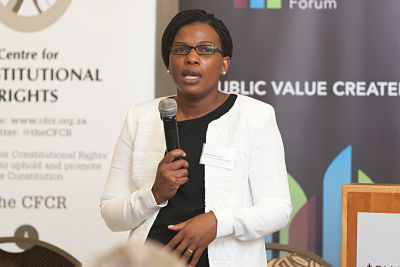 [Speech delivered by Phephelaphi Dube: Legal Officer, Centre for Constitutional Rights, to the Water Catchment Areas CEO Forum, Cape Town, 23 November 2015]
 THE CONSTITUTION AND GOOD PUBLIC LEADERSHIP: BREAKFAST DISCUSSION SERIES 2015
 20 November marks the day on which the United Nations General Assembly adopted the