View Archived Content

ARTICLE: MOTSOENENG EXITS THE SABC

SABC Logo

The South African Broadcasting Corporation (SABC) today announced that former Chief Operations Officer, Hlaudi Motsoeneng, has been dismissed from his position at the public broadcaster. This comes after the SABC’s interim Board accepted the recommendation that he be dismissed, from the Chairperson of the disciplinary committee. Motsoeneng was charged with and found guilty of bringing the SABC into disrepute and causing irreparable damage to his employer after breaching the conditions of his suspension. The verdict comes after a drawn-out hearing, which Motsoeneng tried to stall multiple times.

The charges stem from a press conference held by Motsoeneng in April whilst on suspension, as ordered by the Western Cape High Court in December 2016. The Court also held that Motsoeneng could not hold any position at the public broadcaster unless and until the Public Protector’s report – in which he was named as part of the cause of the disarray at the SABC – was set aside, or a new disciplinary hearing cleared him of wrongdoing.

Read More »

CASE DISCUSSION: THE DUTIES OF POLICE TOWARDS WOMEN – PRETRIAL DETENTION CONDITIONS

police jacket opt

The South Gauteng High Court recently made a ruling concerning the conditions of detention in police holding cells, amongst other issues. The Mathe v the Minister of Police case was an application for damages, as a result of the trauma experienced by the plaintiff at the hands of the South African Police Service (SAPS). Whilst it was action for damages, key constitutional questions were raised.

The facts of the case briefly: the plaintiff and her friends were arrested for the offence of prostitution after being found seated outside a service station, awaiting public transport in the early hours of the morning. An unmarked police vehicle arrived and plainclothes police officers arrested them without first informing them of their rights in terms of section 35(1) of the Constitution. This provision addresses the rights of those arrested for allegedly committing a criminal offence and includes the right to be informed of their rights. The officers also failed to identify themselves as police officers before bundling the women into the vehicle. There was a short exchange before they left for the police station and, in essence,  the women were arrested simply for being women who were seated outside a filling station in the middle of the night.

Read More »

STATEMENT: PHAHLANE – SAPS LEADERSHIP WOES, AGAIN

SAPS foterLieutenant-General Khomotso Phahlane has been removed from his acting position as National South African Police Commissioner. This, against the backdrop of the erstwhile National Police Commissioner, Riah Phiyega, still serving her suspension from the position due to her role in the Marikana killings of striking mine workers. Dare one remind the nation that there is yet to be an individual to complete their term of the helm of the South African Police Service (SAPS)? South Africans are weary of daily revelations of corruption, ineptitude and a State that is seemingly determined to veer the nation off its path of constitutional democracy.

Read More »

ARTICLE: AFRICA DAY – MUCH ADO ABOUT VERY LITTLE

africa globe opt

25 May is the annual commemoration of the founding in 1963 of the Organisation of African Unity (OAU). The OAU was established to “promote unity and solidarity amongst African states” and “to rid the continent of the remaining vestiges of colonisation and apartheid”. This was at the beginning of liberation for many African countries from colonialism, and the collaboration was one of the most visible expressions of pan-Africanism and the intention to cement bonds between African countries. In 2001, the OAU was renamed the African Union (AU). This year, it celebrates its 54th year – over five decades of existence and yet, there seems to be very little to celebrate.

Read More »

ARTICLE: THE BRIAN MOLEFE SAGA IS A FLAGRANT VIOLATION OF CONSTITUTIONAL PRINCIPLES

eskom opt

Did he or did he not resign, or was it retirement – and was his brief stint in Parliament some form of unpaid leave? If Brian Molefe and Eskom could at the very least, decide on a story and stick with it, that would be very least of their problems. At the moment, however, the entire saga has breached several constitutional principles.

First, in terms of section 47 of the Constitution, Members of Parliament, excluding Cabinet Members, their deputies, as well as the President, may not be appointed, or be in service and receive remuneration for that service. Brian Molefe’s claim that he was on unpaid leave as Eskom Chief Executive Officer (CEO) in the time he sat as a parliamentary backbencher violates this particular provision. This means that he was, according to his own version, the de facto Eskom CEO the same time as he was a member of the National Assembly. In any event, some newspapers carried an advertisement for the Eskom CEO position, issued by the Eskom Board. This suggests then, that his initial departure from Eskom was meant to be permanent and was anything but unpaid leave.

Read More »

ARTICLE: UNIVERSITIES’ LANGUAGE POLICIES AT A CROSSROADS? THE INTERPRETATION OF ADMINISTRATIVE ACTION*

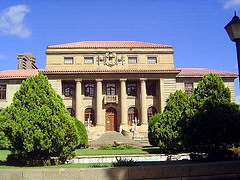
sca bloemfonteinThis is the second article in a series of four analysing the recent Supreme Court of Appeal judgment in the matter of University of the Free State v Afriforum and Another (SCA judgment).

A crucial finding made in the SCA judgment related to the reviewability of the University of the Free State’s decision (UFS decision) to replace its dual-medium language policy with a single-medium language policy. The SCA held that the UFS’s decision was not “administrative action” as defined in the Promotion of Administrative Justice Act of 2000 (PAJA) and therefore only the rationality of the decision could be reviewed by the Court. The aforesaid finding, given the provisions of section 29(2) of the Constitution, is the key issue to be decided in Afriforum’s appeal to the Constitutional Court.

Read More »

INVITATION: NPA ROUNDTABLE DISCUSSION

170531 CFCR NPA Roundtable Invitation opt

Please join the Centre for Constitutional Rights (CFCR) and the Africa Criminal Justice Reform (ACJR), a programme of the Dullah Omar Institute (University of the Western Cape), for a Roundtable Discussion on the importance and work of the National Prosecuting Authority (NPA). Some of our speakers will reflect on the appointment, performance and dismissal of the Head of the NPA and its Directors in terms of the National Prosecuting Authority Act (NPA Act). In light of serious concerns around the politicisation of the institution, it is hoped that this Roundtable Discussion will lead to considerations on possible amendments to the NPA Act or the Constitution, to ensure the accountability of the NPA and upholding of its constitutional mandate.

Read More »

ARTICLE: INSERTING FOOD SECURITY INTO THE LAND DEBATE

farm

Section 27(1) and (2) of the Constitution guarantee every citizen the right to sufficient food, whereby the state must take reasonable measures to ensure the realisation of this right.  To ensure fulfilment of this constitutional imperative, Cabinet approved the National Policy on Food and Nutrition Security (the Policy) in 2013. The Policy seeks to improve food production and distribution and promotes smallholder production, which is interchangeably used with “subsistence farming”, “community-based farming”, or “peasant farming”. While smallholder farmers have limited resources, they play an integral role in creating livelihoods and ensuring food production amongst the poor-rural population. The Policy envisaged a framework to safeguard the right to sufficient food, however food insecurity remains pervasive. 

In 2016, the Department of Agriculture, Forestry, and Fisheries (DAFF) Annual Report 2016 stated that although the country can meet food requirements under normal weather conditions, 14 million South Africans are vulnerable to hunger and have insufficient access to food.  Additionally, the Statistics South Africa (StatsSA) Community Survey 2016 showed that 2.2 million households reported skipping a meal in the past year, and 3.3 million households reported they had run out of money to buy food in the last 12 months.

Read More »