
ARTICLE: BEYOND STATE CAPTURE AND CORRUPTION

On February 2, 1990, to the surprise of both friend and foe – and only four months into his term as president – FW de Klerk announced that he would unconditionally release Nelson Mandela and other political prisoners, and unban the ANC and other organisations. The goal was to create the circumstances within which negotiations on the future of South Africa could take place. As a result, he opened the door for a new future and the Nobel Peace Prize was awarded to him (and Nelson Mandela).
The FW de Klerk Foundation was established in 1999 to promote and protect FW de Klerk’s most important legacy: the Constitution of the Republic of South Africa. The Foundation has since commemorated 2 February 1990 each year by holding a national conference. The themes of these conferences are usually devoted to the most burning issues in the country.
This year’s theme was “Beyond state capture and corruption”. The intention was to move beyond the analysis of the origin and implementation of state capture and to give the audience (and the country and its people) hope for a better future. The words and actions of newly-elected ANC President Cyril Ramaphosa were cautiously welcomed. One could only wonder how it would be possible to broach such a topic if Nkosazana Dlamini-Zuma had been elected as ANC president.
INVITATION: ROUNDTABLE SERIES 2018 – NUMBER 1
Join us for a discussion hosted by the Centre for Unity in Diversity (CUD), supported by the Konrad Adenauer Foundation (KAS).
ARTICLE: UNELECTED PRESIDENT?
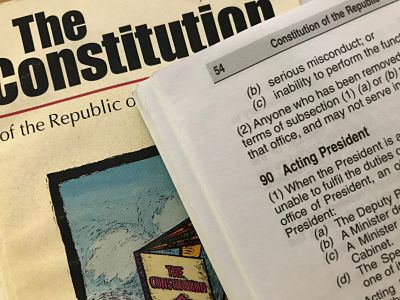
In 1973, the Watergate Scandal broke, eventually costing United States of America’s President Richard Nixon his scalp in 1974. The Deputy President, Gerald Ford, was appointed, unelected, into the position, which he held for three more years. He holds the distinction as the only unelected President of the USA in the 20th Century. Back home, the Constitution contemplates such a scenario, albeit for a temporary period.
Specifically, section 90 of the Constitution governs the eventuality of an Acting President in circumstances where the President is “absent from the Republic or otherwise unable to fulfil the duties of President, or during a vacancy in the office of President”. Prior to assuming the office of the President, the Acting President “must swear or affirm faithfulness to the Republic and obedience to the Constitution”.