
CASE DISCUSSION: DOBROSAV GAVRIĆ V REFUGEE STATUS DETERMINATION OFFICER, CAPE TOWN AND OTHERS

In September 2018, the Constitutional Court ruled in an application by Mr Dobrosav Gavrićfor leave to appeal a Western Cape High Court judgment, which confirmed the decision of the Refugee Status Determination Officer (RSDO) to refuse to grant Gavrić refugee status in terms of the Refugees Act (the Act). This case was important because it emphasises South Africa’s international law obligations under the principle of nonrefoulement – the general prohibition against the return of a person to any country where that person’s life, physical safety or freedom will be threatened. The judgment also establishes a test for the vagueness of the term “political crime” as a requirement for the granting of refugee status.
ARTICLE: TO REVEAL SOURCES? WHAT DOES THE PUBLIC INTEREST DEMAND?

In a country where freedom of expression, including freedom of the press and other media, is well-protected and enjoyed – at least on paper – can there ever be compelling, public interest reasons for journalists to reveal their sources?
South Africa was recently gripped by revelations emanating from the Commission of Inquiry into tax administration and governance at the South Africa Revenue Service (SARS) headed by retired Judge Nugent. Not least among the revelations is that the widely reported ‘rogue unit’ within SARS was in fact, the High-Risk Investigations Unit, lawfully constituted, with extensive search and seizure powers. Such powers enabled tax assessments and recovery of illicit tobacco, drugs and counterfeit clothing worth more than R4 billion in the time of its existence. Despite this, the Sunday Times newspaper published a series of articles in which senior-ranking SARS officials were implicated in the establishment of a covert or “rogue” investigative unit that allegedly spied on former President Jacob Zuma and that set up a brothel aimed at infiltrating the governing party. The paper has since retracted the stories regarding the rogue unit and has tendered an apology.
STATEMENT: UPDATE ON FORMER PRESIDENT FW DE KLERK
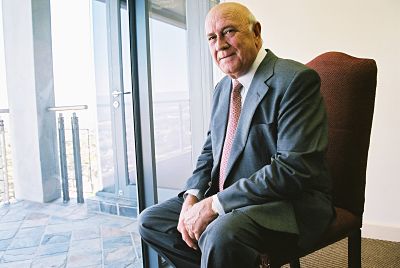
The FW de Klerk Foundation is delighted to announce that former President FW de Klerk was discharged from Panorama Mediclinic in Cape Town this afternoon, following a successful procedure on Saturday to treat pneumothorax.
Mr and Mrs De Klerk, as well as the Foundation, would like to express their sincere thanks for all the good wishes and messages of support they have received over the past few days.