
ARTICLE: DIMINISHING THE POWER OF DISCRIMINATION
 The killing of 69 unarmed people in Sharpeville, South Africa, protesting apartheid pass laws on 21 March 1960, stirred the conscience of the world and saw the United Nations General Assembly adopt a Resolution to declare the day International Day for the Elimination of Racial Discrimination in 1966. ‘Sharpeville Day’ also became the origin for the post-1994 government of South Africa’s Human Rights Day, declared a public holiday.
While definitions of racism and racial discrimination are varied, at the heart of the matter is prejudice that is embedded in race, colour, ethnicity and often the combination of these. The UN, in its International Convention on All Forms of Racial Discrimination (1965), defines it thus, “the term ‘racial discrimination’ shall mean any distinction, exclusion, restriction, or preference based on race, colour, descent, or national or ethnic origin that has the purpose or effect of nullifying or impairing the recognition, enjoyment or exercise, on an equal footing, of human rights and fundamental freedoms in the political, social, cultural or any other field of public life”.
ARTICLE: THE LAND QUESTION – BLACK UNITY AND NO COMPENSATION OR NON-RACIALISM AND CONSTITUTIONALISM?
 In his State of the Nation (SONA) appearance, President Zuma said “we had stated our intention of using the Expropriation Act, 1975 (Act 63 of 1975) to pursue land reform and land redistribution, in line with the Constitution” (my emphasis).
In debating this, the Minister of Rural Development and Land Reform, Gugile Nkwinti, on 14 February, said that the Government will undertake a pre-colonial audit of land ownership and “(o)nce the audit has been completed, a single law should be developed to address the issue of land restitution without compensation. The necessary constitutional amendments should be undertaken to effect this process”.
At the launch of Operation Phakisa’s agriculture, land reform and rural development leg on 24 February, Zuma asked the following rhetorical (and nonsensical) question: “How are we going to achieve all the goals mentioned in the State of the Nation Address and all the laws and policies that we are busy amending to enable faster land reform, including land expropriation without compensation as provided for in the Constitution” (my emphasis). On 3 March, in his official opening of National House of Traditional Leaders, the President repeated the Nkwinti statement almost verbatim. Land reform “in line with the Constitution” has quickly become “land restitution without compensation”.
ARTICLE: SASSA – MUDDLING THROUGH AS THE POOR WAIT
The last few days have witnessed a SASSA fiasco on an unprecedented scale.
ARTICLE: FOUR MYTHS DEBUNKED

The FW de Klerk Foundation was established in 1999 to promote and protect the Constitution and its values, as well as to commemorate the transition to democracy in the early 90s. Each year, the Foundation hosts its Annual Conference around 2 February to commemorate former President FW de Klerk’s historic speech on that day in 1990 – when the transition formally started with announcement that political parties would be unbanned and political prisoners (among which Nelson Mandela was the most prominent) were to be released. This Conference was held in Cape Town this year on Friday, 31 January, 30 years after this momentous speech.
STATEMENT: THIRTIETH ANNIVERSARY OF THE RELEASE FROM PRISON OF NELSON MANDELA

The release of Nelson Mandela from prison 30 years ago was the first momentous consequence of the announcements made by President FW de Klerk in Parliament nine days earlier. As Mr De Klerk observed in his autobiography: as he watched Nelson Mandela walking through the gates of Victor Verster Prison, he was struck by an inescapable truth: “…an irreversible process had begun and nobody could predict precisely how it would end.”
Now 30 years later we can answer part of that question:
- the constitutional democracy that FW de Klerk and Nelson Mandela took the lead in negotiating during the following six years is still intact;
- South African has rejoined the international community;
- it has rid itself of the albatross of minority racial domination;
- all South Africans enjoy nominal equality;
- the new multi-racial middle class has flourished.
INVITATION: POST SONA: THE ANSWERS WE WANT
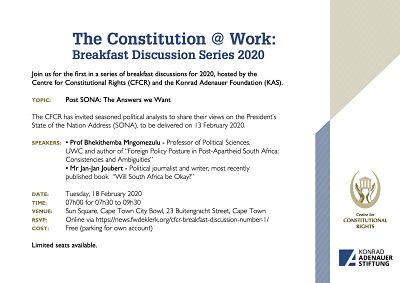
*** EVENT POSTPONED***
Join us for the first in a series of breakfast discussions for 2020, hosted by the Centre for Constitutional Rights (CFCR) and the Konrad Adenauer Foundation (KAS).
Topic: Post SONA: The Answers we Want
The CFCR has invited seasoned political analysts to share their views on the President’s State of the Nation Address (SONA), to be delivered on 13 February 2020.