THE FW DE KLERK FOUNDATION CHALLENGES BELA BILL’S EROSION OF LANGUAGE RIGHTS
The FW de Klerk Foundation submitted written comments to the Minister of Basic Education today regarding the Basic Education Laws Amendment Bill, which proposes to amend

The FW de Klerk Foundation submitted written comments to the Minister of Basic Education today regarding the Basic Education Laws Amendment Bill, which proposes to amend
Reports that students have been prohibited from speaking Afrikaans – even in private conversations – at the University of Stellenbosch – are deeply disturbing. They are the latest development in the sorry decline of the language at South Africa’s oldest (and once-upon-a-time) Afrikaans university.
Our history mirrors the troubled histories of many other countries in North and South America and Australasia that were ‘discovered’ and settled by Europeans between the sixteenth and nineteenth centuries. The indigenous populations were conquered, some were enslaved and nearly all lost their ancestral lands. As Chief Red Cloud of the Sioux observed: “They made us many promises, but they kept only one: they promised to take our land – and they did.” Some indigenous people died resisting the invaders – but many, many more succumbed to the settlers’ diseases – perhaps as many as 90% of the population of South and Central America.
The EFF obtained a permit for a demonstration by 100 people. In the event, an estimated 2 000 of its supporters descended on the suburb. Hardly any of the protesters wore masks and far exceeded the 500 permitted at outdoor meetings under COVID19 regulations. According to the SAHRC some protesters were carrying golf clubs, axes and stones. They caused serious damage to the Brackenfell Post Office, to traffic lights and roads and to a car dealership. They burned a fire engine and set fire to grass.
Last Friday both Fitch Ratings and Moody’s Investor Services downgraded South Africa’s sovereign risk rating by a further notch each, pushing the country yet further into junk status. South Africa is now at ‘its lowest credit rating levels…since 1994’, said the Treasury in its reaction.

ONDERWERP: IS PLAASLIKE REGERING DIE SWAKSTE SKAKEL? SOSIALE GEREGTIGHEID, DIENSLEWERING EN AANSPREEKLIKHEID
Spreker: Dr Makhosi Khoza, Uitvoerende Direkteur, OUTA Plaaslike Regering Strategie
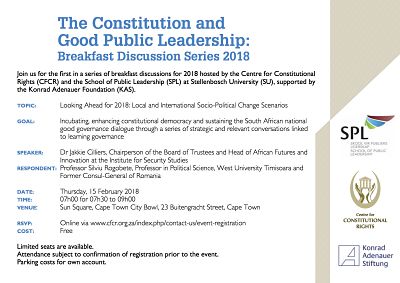 THE CONSTITUTION AND GOOD PUBLIC LEADERSHIP: BREAKFAST DISCUSSION SERIES 2018
TOPIC: LOOKING AHEAD FOR 2018: LOCAL AND INTERNATIONAL SOCIO-POLITICAL CHANGE SCENARIOS
Speaker: Dr Jakkie Cilliers, Chairperson of the Board of Trustees and Head of African Futures and Innovation at the Institute for Security Studies
Respondent: Professor Silviu Rogobete, Professor in Political Science, West University Timisoara and former Consul-General of Romania
 DIE GRONDWET EN GOEIE PUBLIEKE LEIERSKAP: ONTBYTBESPREKINGSREEKS 2018
ONDERWERP: TOEKOMSBLIK VIR 2018: PLAASLIKE EN INTERNASIONALE SOSIO-POLITIEKE SCENARIOS VIR VERANDERING
Spreker: Dr Jakkie Cilliers, Voorsitter van die Raad van Trustees en die Hoof van African Futures and Innovation by die Instituut vir Sekerheidstudies
Respondent: Professor Silviu Rogobete, Professor in Politieke Wetenskap, West University Timisoara en voormalige konsul-generaal van Roemenië

On 10 November 2017, the Centre for Constitutional Rights (the Centre) added its voice of opposition to the Draft Basic Education Laws Amendment Bill (the Bill), which amends the South African Schools Act of 1996 (Schools Act).
The Centre’s submission was restricted to the amendments pertaining to admission and language policies of public schools. A public school’s School Governing Body (SGB) currently has the exclusive power to determine these two policies. Essentially the amendments propose that these two policies must be approved by the Head of the Provincial Education Department (HoD), based on certain undefined factors. Additionally, the HoD may also “direct” a public school to adopt an additional language of instruction if “practicable”.