Introduction
Election campaigns are often loud and emotional. Politicians use powerful words to win support, challenge their opponents and inspire their followers. But what happens when those words appear to encourage violence? When does political speech cross the line? These questions were at centre of the South African Human Rights Commission and Another v Malema and Another. The Western Cape High Court, sitting as an Equality Court, had to decide whether comments made by the prominent politician and head of the Economic Freedom Fighters (“EFF”) political party, Julius Sello Malema were protected by the right to freedom of speech, or whether they amounted to prohibited hate speech.
The judgment is about more than one political speech. It explains that freedom of expression is one of South Africa’s most important constitutional rights. It also shows that this right has limits. People may speak freely and take part in political debate. However, the Constitution explicitly does not protect speech that is propaganda for war; incitement of imminent violence or hate speech (advocacy of hatred that is based on certain grounds that constitutes incitement to cause harm).
What happened at Brackenfell High School?
The case began with the events at Brackenfell High School in November 2020: Members of the EFF protested outside the school twice (on 6 November and 9 November). They believed Black learners had been excluded from a private matric farewell event. (The school’s official event had been cancelled due to COVID-19 and invitations to the private function were sent to all matriculants and teachers, and was open even to pupils at other schools.) The protest occurred during the matric exams and a group of parents, local residents, and security guards confronted the protesters. Several EFF members were assaulted in the second protest during the clashes with the residents group.
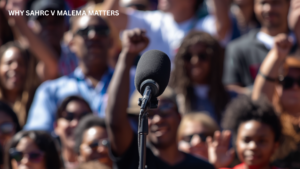
Almost two years later, on 16 October 2022, Mr Julius Malema addressed an EFF gathering. He spoke about what had happened at Brackenfell. He criticised EFF members for not having followed one of the residents (a White male that had assaulted an EFF member) to “attend” properly to him when he was alone in an isolated space.
He said they must “never be scared to kill. A revolution demands that at some point there must be killing because the killing is part of a revolutionary act.”
The speech quickly attracted public attention with the South African Human Rights Commission (“SAHRC”) receiving hundreds of complaints. The SAHRC believed some of Mr Malema’s comments encouraged violence and targeted people because of their race. It approached the Equality Court and argued that the statements amounted to hate speech.
Where does the law draw the line?
The right to freedom of expression allows people to express their views, criticises those in power and take in part on political debate. However, this right does not extend to all speech. The Constitution does not protect hate speech as part of the right to freedom of expression. Because hate speech is unprotected speech, the State can regulate it as it sees fit. This is where the Promotion of Equality and Prevention of Unfair Discrimination Act, 2000 (“the Equality Act”) comes into play, with its section 10 prohibiting hate speech.
Importantly, the Equality Act imposed civil liability (i.e. it does not result in a jail sentence or a criminal record). The Prevention and Combating of Hate Crimes and Hate Speech Act, 2023 is the law that criminalises hate speech.
The Court faced one important question. Did Mr Malema’s words amount to hate speech? According to of the Equality Act, hate speech refers to speech that is based on a prohibited ground, such as race, and shows a clear intention to cause harm (or incite it) and stir up hatred.
South African courts have explained that harm is not limited to physical violence. Hate speech can also cause emotional, psychological and social harm. It can make people feel unsafe, humiliated or excluded, because they belong to a particular group. The law protects people from this kind of harm as well. The Court, therefore, had to decide not only what Mr Malema meant, but also how his audience was likely to understand his words.
How did the Court interpret the speech?
A key issue was whether Mr Malema’s words about killing were simply metaphorical and political rhetoric. The Court did not look at Mr Malema’s words in isolation. It looked at the full context – political, ideological and textual. It considered who made the speech, who was listening and the words used. It also considered how a reasonable person would understand the words.
What did the Court order?
After considering all the evidence, the Court found that Mr Malema’s statements amounted to hate speech under section 10 of the Equality Act. It declared that the speech was based on race, promoted hatred and incited harm. The Court also ordered Mr Malema and the EFF to pay the legal costs of the case. (As the Court held them jointly and severally liable, the complainants may recover the full amount from either Mr Malema or the EFF. If one pays the full amount, the other is no longer liable for those costs.) The Court also ordered Mr Malema and the EFF to pay the costs of the complainants’ expert witness and two legal counsels.
Why this matters to South Africans
This case shows the limits of political speech. It demonstrates that politicians are not excused when they commit hate speech – indeed, that everyone is “equal before the law”. The Equality Act protects people from hate speech based on race and other prohibited grounds, including religion, gender, disability and sexual orientation. These protections apply to everyone.
The judgment is especially important as South Africa prepares for the upcoming local government elections next month. Political campaigns often involve passionate speeches and heated debate. Leaders have the right to criticise their opponents and persuade voters. However, this case reminds them that not all speech is protected by the right to freedom of expression. Strong political debate strengthens democracy, but words that encourage violence cross the constitutional line.