View Archived Content

ARTICLE: CHILD PROTECTION WEEK 2019
CPW opt

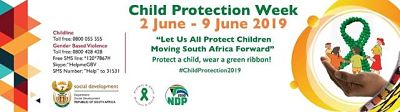
This year, Child Protection Week (CPW) South Africa runs from 2 June to 9 June. The chosen theme, “Let us Protect All Children to Move South Africa Forward” speaks to the collective responsibility that the South African community bears to actively participate in the protection and promotion of children and their rights. It suggests, accurately, that this mandate is one that belongs to everyone and not just the designated departments in government and organisations in civil society that have dedicated their efforts to children.

CPW is an initiative of the Department of Social Development and commenced in 1997. For over 20 years, South Africans have received a call to action for a week, annually, to do something that by rights, should be an everyday conscious effort on behalf of the most vulnerable of our society. CPW aims to raise awareness of children’s rights, as articulated in section 28 of the Constitution, as well as in other children-specific legislation, such as the Children’s Act. South Africa’s duties are also enunciated in international agreements such as the African Charter on the Rights and Welfare of the Child (ACRWC) and the United Nations Convention on the Rights of the Child (CRC). 
Read More »

ARTICLE: SURVEILLANCE LAW UNDER SPOTLIGHT – THE LONG-AWAITED CONSTITUTIONAL CHALLENGE TO RICA

PRIVACY opt

Today, 4 June 2019, the Pretoria High Court is hearing a critical and long-awaited constitutional challenge to the Regulation of Interception of Communications and Provision of Communication-Related Information Act of 2002 (RICA) in Amabhungane Centre for Investigative Journalism NPC and Another v the Minister of Justice and Correctional Services and Others.

For the ordinary man on the street, RICA is synonymous with the tedious process of SIM card registration and the list of personal information that one needs to provide to a mobile service provider. However, many are not aware that this Act also regulates the interception of communication, such as phone calls and emails (and “communication-related information”, also known as meta-data) by certain State agents. This aspect of RICA lies at the core of the constitutional challenge.

Read More »

ARTICLE: POST 2019 ELECTIONS: TIME FOR ELECTORAL REFORM AND DUSTING OFF THE VAN ZYL SLABBERT REPORT

iec

In the aftermath of a highly-contested national and provincial election, questions must be asked why only 65.99% of registered voters turned out to vote, compared with 89.3% in 1999. There might be many factors contributing to this low turnout, such as voter disillusionment following State capture, corruption, lack of accountability and an ailing economy. However, there are other possible explanations:  it may be that voters do not feel that they are properly represented by the people who sit in Parliament; and that Parliament has simply become a rubber stamp in the hands of the Executive.  

The real problem may be the lack of a proper relationship between voters and their representatives in Parliament – the root of which, may lie in our electoral system itself.

Read More »

INVITATION: POST ELECTIONS 2019 – FINDING OUR WAY BACK TO A CONSTITUTIONAL DEMOCRACY

190529 CFCR INVITE optTHE CONSTITUTION @ WORK

Join us for the first in a series of breakfast discussions for 2019 hosted by the Centre for Constitutional Rights (CFCR) and the Konrad Adenauer Foundation (KAS). 

Topic: Post Elections 2019 – Finding our Way Back to a Constitutional Democracy
Unpacking critical reforms needed, potential cabinet appointments, priorities for the 6th democratic Parliament and managing the expectations of citizens

Read More »

ARTICLE: WORLD PRESS FREEDOM DAY 2019 – MEDIA FOR DEMOCRACY

wpfd2019

World Press Freedom Day is commemorated on 3 May annually to emphasise the fundamental principles of press freedom, to defend the media from attacks on its independence, to evaluate the state of press freedom across the globe and to pay tribute to journalists who have lost their lives in the line of duty and continue to brave unsafe digital and physical spaces for the sake of the truth.

The United Nations Educational, Scientific and Cultural Organisation (UNESCO) has identified this year’s theme as “Media for Democracy: Journalism and Elections in Times of Disinformation”. This theme could not be more apt as numerous democracies, including South Africa, gear up for election season. For the majority of voters across the world, the press remains the sole source of information about the political parties contesting elections. From the individuals seeking election, to the manifestos of the parties, containing promises and assurances in exchange for votes come polling day. The discerning and privileged voter has the tools by which to analyse the information available and make informed decisions.

Read More »

ARTICLE: PRIVATE PROSECUTION IN THE SECURING OF A SUSTAINABLE FUTURE

girl plant

Environmental rights are protected in the Bill of Rights of the South African Constitution. Whilst all the protected rights and freedoms have the common thread of “protection for all”, only section 24 of the Constitution (right to a healthy environment) includes the caveat “for the benefit of present and future generations”. No other right or freedom covers future generations so explicitly or expressly (although it can be inferred that they are catered for regardless). The writers of the Bill of Rights were mindful of the importance of a sustainable planet, to allow for an inhabitable earth for those yet to come. 

Read More »

STATEMENT: RESETTING THE NPA ON THE PATH TO INDEPENDENCE

npa

According to a statement by the Presidency of 26 April 2019, the President notified Advocates Nomgcobo Jiba and Lawrence Mrwebi on 25 April that they are removed from their positions as Deputy National Director of Public Prosecutions (DNDPP) and Special Director of Public Prosecutions, respectively. The decision accordingly follows the recommendations made by the Mokgoro Commission of Enquiry into the fitness of the two advocates to fulfil senior positions within the Office of the National Prosecuting Authority (NPA). 

In line with section 12 of the National Prosecuting Authority Act (NPA Act) the President was required to decide within six months from the time he announced their provisional suspension (pending the enquiry into their fitness to hold office within the NPA) whether they had to be removed. 

Read More »

ARTICLE: LET THE ELECTORATE, NOT THE CORRUPT, SET POLICIES

Section 19 opt

With a mere two weeks until South Africa’s sixth National Elections, the election campaigns of all contesting parties are trying to tell us who to vote for.  Do we want to “grow South Africa together”, “one South Africa for all” or rather, “our Land and Jobs now”? Though some might be tired of hearing empty promises, national elections are the key mechanism through which the people can set the policies they have to live, work, study and parent under. Therefore, a competitive and fair ‘marketplace of ideas’, in other words, policy-focused elections, are vital. But for this to be true, an underlying assumption needs to be tested: do the freely elected head of government and national legislative representatives determine government policies?

Read More »

ARTICLE: NO MORE IGNORING THE AUDITOR-GENERAL’S RECOMMENDATIONS: THE MATERIAL IRREGULARITY REGULATIONS READ WITH THE PUBLIC AUDIT AMENDMENT ACT OF 2018

AuditorGeneral

For at least the last five years, the Auditor-General (AG), a Chapter 9 institution constitutionally-mandated to audit the financial statements of all national and provincial departments, municipalities and State-Owned Enterprises (SOEs), has emphasised the alarming regression in clean audit outcomes. This regression, according to the AG’s Consolidated General Report on National and Provincial Audit Outcomes 2017-2018 was mainly due to the flagrant disregard of the AG’s audit recommendations. Not only did fruitless and wasteful expenditure increased by over 200% from the previous year, to R2.5 billion, but at national level, clean audits appallingly regressed to 23%, from an already paltry 30% in the previous financial year. 

Read More »