The most revealing test of a political leader comes when the interests of the party and the interests of the country no longer align. It is then that patriotism comes at a price: the displeasure of colleagues, the surrender of political advantage, perhaps the loss of office itself.
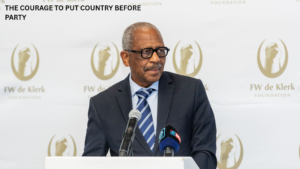
At the Fifth FW de Klerk Memorial Lecture on 11 November, an annual event by the FW de Klerk Foundation that commemorates the life and political leadership of former President FW de Klerk, Dr Mathews Phosa brought that uncomfortable test into focus. Speaking on “The Enduring Promise of Constitutional Democracy”, the liberation veteran and constitutional negotiator challenged current leaders to place South Africa’s future above their organisations’ survival. He reminded the audience that “No party owns the electorate.”
The courage to change course
Dr Phosa recalled De Klerk’s decision in February 1990 to unban liberation movements and open the way to negotiations. Recognising that contribution neither diminishes apartheid’s injustice nor discounts the struggle against it. It acknowledges that a consequential act of leadership involved relinquishing political power and accepting a future whose outcome could no longer be controlled.
Today’s circumstances are profoundly different, but the demand for political courage remains. It arises whenever leaders must confront wrongdoing among allies, accept an electoral setback or acknowledge that a policy defended for years has failed the people it was meant to serve.
The dilemma extends beyond South Africa. In his 1796 Farewell Address, George Washington warned of the damage that partisan passions could inflict on the common interest. Our Constitution rightly embraces multiparty democracy; parties organise legitimate differences and give voters meaningful choices. The danger arises when loyalty to an organisation eliminates critical thinking and becomes a justification for sacrificing the public good.
Loyalty has constitutional limits
South Africa has already given that distinction legal force. Section 42(3) of the Constitution makes the National Assembly responsible for representing the people and scrutinising executive action. A governing party’s parliamentary strength therefore carries an obligation to examine its own government’s conduct, including when the findings are politically inconvenient.
In United Democratic Movement v Speaker of the National Assembly, the Constitutional Court explained that MPs swear faithfulness to the Republic and obedience to the Constitution and laws. Where constitutional values conflict with party loyalty, their undertaking to serve the people must prevail. That principle emerged from litigation over a secret ballot in a presidential no-confidence vote, but its significance reaches into the everyday work of oversight.
An oath matters most when it becomes inconvenient. Otherwise, the ceremony survives while the obligation disappears.
A committee member confronted with credible evidence of waste of public funds must insist on answers, even when the responsible minister is a colleague. Party discipline helps elected representatives pursue a programme; it cannot excuse abandoning the constitutional duties that make their authority legitimate.
This is where the language of betrayal needs to be challenged. A representative who asks difficult questions of their own party’s government may be honouring the very people who elected it, particularly when silence allows public money to be wasted or services to fail.
Make accountability easier to exercise
Dr Phosa’s argument also invites examination of the incentives shaping political behaviour. He proposed considering a directly elected President, questioning whether the present arrangement creates excessive dependence on party structures. That proposal deserves careful public debate about how citizens choose their leaders and hold them accountable between elections.
The FW de Klerk Foundation has undertaken extensive work on electoral reform, including submissions and advocacy for stronger connections between voters and their representatives. The Foundation’s engagement proceeds from the need to strengthen democratic accountability and meaningful public participation.
Any proposed system must be tested against that purpose. A separate presidential ballot would still require effective parliamentary scrutiny and safeguards against abuse. Citizens need to know how a president would answer for failure, especially when presidential and parliamentary majorities differ.
Meanwhile, the existing duties of public office remain binding. Parliamentary committees should pursue unanswered questions, require credible explanations for missed commitments and follow up on corrective action. Political parties should support that scrutiny within their own ranks and judge colleagues’ performance by the same standards they apply to political opponents.
Putting country before party becomes real through such decisions. For residents waiting for water, functioning schools or accountable public spending, its value lies in whether someone with authority is prepared to challenge failure despite the political cost.
Dr Phosa’s lecture deserves to outlive the evening on which it was delivered. Its challenge is whether those entrusted with power will honour their constitutional responsibilities when doing so threatens their own position and privileges.
For more on this topic read: Why South Africa Needs Electoral Reform: A Look at Mixed-Member Proportional Systems – https://fwdeklerk.org/why-south-africa-needs-electoral-reform-a-look-at-mixed-member-proportional-systems/?utm_source