MENTAL HEALTH FOR ALL – NOT A REALITY IN SOUTH AFRICA
“Make mental health for all a global priority” is the theme for this year’s World Mental Health Day, which is marked annually on the 10th

“Make mental health for all a global priority” is the theme for this year’s World Mental Health Day, which is marked annually on the 10th
It is with great sadness that the FW de Klerk Foundation has learned of the passing of Great Britain’s longest serving monarch, Her Majesty Queen
Three pieces of legislation currently before Parliament pose a serious renewed threat to property rights – and underline the ANC’s determination to proceed with some
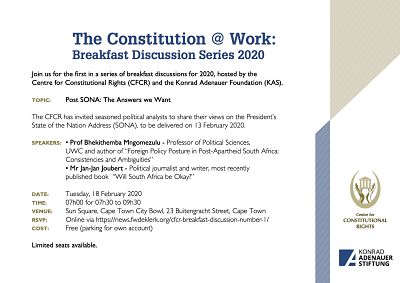
*** EVENT POSTPONED***
Join us for the first in a series of breakfast discussions for 2020, hosted by the Centre for Constitutional Rights (CFCR) and the Konrad Adenauer Foundation (KAS).
Topic: Post SONA: The Answers we Want
The CFCR has invited seasoned political analysts to share their views on the President’s State of the Nation Address (SONA), to be delivered on 13 February 2020.

On 1 January 2020, the Refugee Amendment Act of 2017 (Amendment Act), together with its Regulations (2018), came into operation. What could have been a positive amendment to address the myriad of challenges faced by the South African refugee and asylum systems has, rather, served to further curtail the rights and protections extended to this vulnerable group by both international law and domestic legislation.
The 1951 United Nations Convention Relating to the Status of Refugees (Refugee Convention) is explicit in the fundamental protections for asylum-seekers and refugees. One of the most important protections extended to refugees is the international law principle of non-refoulement. It is a French term that, according to the Refugee Convention, proscribes governments from the expulsion or return of a refugee “against his or her will, in any manner whatsoever, to a territory where he or she fears threats to life or freedom”. Non-refoulement is so fundamental that no reservations or derogations may be made to it – regardless of whether the State concerned is party to the Refugee Convention.

The Centre for Constitutional Rights (CFCR) has written to the Chairperson of the Ad Hoc Committee Tasked with Initiating and Introducing Legislation to Amend Section 25 of the Constitution, urgently requesting an extension of the deadline for public comment. On 13 December 2019, Parliament published an invitation in the Government Gazette, calling on the public to provide written submissions on the draft Constitution 18th Amendment Bill by 31 January 2020.
In brief, the draft Constitution 18th Amendment Bill proposes amending section 25 of the Constitution to provide that the Courts may determine that in certain specific circumstances – stipulated in legislation – it will be “just and equitable” in terms of section 25(3) of the Constitution that the amount of compensation for the expropriation of land and any improvements thereon, for the purposes of land reform, be nil.

10 December is commemorated annually as International Human Rights Day. The date has particular significance, as it is the date on which the Universal Declaration of Human Rights (UDHR) was adopted by the United Nations General Assembly in 1948. The UDHR was born following the end of World War II and recognises that everyone is entitled to fundamental human rights protection. The UDHR articulates and enumerates universal inalienable rights such as equality and dignity, regardless of grounds like race, colour, religion, sex, national or social origin. While it is not a binding document, the UDHR is the foundation for over 60 human rights instruments across the world, including the South African Constitution.
10 December also happens to be the culmination of the United Nation’s annual 16 Days of Activism Against Gender-Based Violence Campaign. During these 16 days, society is urged to ponder upon the scourge of gender-based violence and to consistently speak up against it, act against it and advocate for victims and survivors. The devastating irony is that in South Africa, in the middle of this awareness campaign, the reports of missing or murdered women and children continued to pour in. It is therefore apt that this day calls for a reflection on what it means to be a human rights bearer and the history of disenfranchisement that far too many communities of vulnerable people have yet to overcome. The poor protection record permeates more than just gender-based violence and is not limited to South Africa.
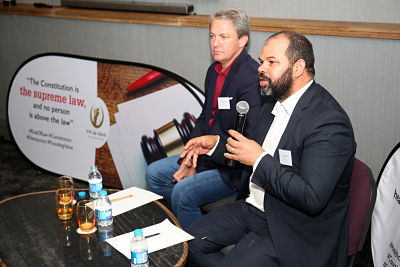
On Thursday 28 November, the Centre for Constitutional Rights (CFCR) and the Konrad Adenauer Foundation (KAS) hosted the final of a series of topical discussions for 2019. The discussion series aims to bring together stakeholders from like-minded institutions, representatives of foreign communities, members of the public at large and any other interested parties, to allow for the sharing of thoughts, opinions and solutions.
The topic was “Unpacking the NHI Bill”. With the deadline for submissions on NHI due on 29 November 2019 the CFCR invited two speakers, Mr Michael Settas, member of the Free Market Foundations’ Health Policy Unit, and Mr Russell Rensburg, Executive Director of the Rural Health Advocacy Project. Speakers shared their thoughts on the proposed NHI and whether this financing system could achieve Universal Health Care (UHC).

World Aids Day is commemorated on 1 December annually. The day is dedicated to uniting people across the globe to join the fight against HIV, to raise awareness and to remember those who have tragically lost the fight against HIV. The theme for the UNAIDS’s 2019 campaign is “Communities make the Difference”, which emphasises the invaluable contribution communities make in combatting the HIV/AIDS epidemic. The theme is in line with the National Wellness Campaign by the Department of Health called “Check Impilo”- a call to action for individuals to take responsibility for their health and wellness.
Communities undeniably form the lifeblood of an effective response to AIDS and an important pillar of support. According to UNAIDS, communities – including peer educators, counsellors, civil society organisations, people living with HIV and affected by it – play a critical role in ensuring that the response to AIDS remains people-centred. Community leadership and advocacy also play a vital role in breaking down barriers to service delivery in the fight against AIDS.