ARTICLE: WHAT AFRICA NEEDS
On the 25 May 2018, the Continent will ring in 55 years of the declaration of Africa Day.

On the 25 May 2018, the Continent will ring in 55 years of the declaration of Africa Day.
Large posters atop buildings, along highways and roads commemorate 24 years since the genocide in Rwanda with the words Kwibuka24-remember-unite-renew (Remembrance24).
The Section 38 Inquiry Report released by Judge Bernard Ngoepe on 7 May 2018 confirms the harm caused by Minister Bathabile Dlamini in her previous role of Minister of Social Development to the South African Social Security Agency (SASSA), and potentially to the lives of 17 million grant beneficiaries.

There is a common view among some South Africans that after 24 years of democracy, less than 10% of the land in South Africa belongs to the majority of the population. Someone began to circulate the narrative that the biggest issue relating to the slow pace of land reform is the ‘willing seller, willing buyer’ principle – and that this is prescribed by the Constitution (which is untrue). Together with this, the second biggest obstacle is described as the “equitable compensation” for land, which is prescribed in section 25 of the Constitution. That’s where the call for expropriation without compensation (EWC) originated and gained momentum. Change section 25 of the Constitution, return land without any compensation and the “original sin” will simply vanish in a flash!
What really went wrong? Who should get the blame? Is it the property owners who resolutely cling to their (for some, stolen) land? Is it the estate agents and brokers? Section 25(5) requires that the State “must take reasonable legislative and other measures, within its available resources, to foster conditions which enable citizens to gain access to land on an equitable basis”. Furthermore, 25(8) states: “No provision of this section may impede the State from taking legislative and other measures to achieve land, water and related reform, in order to correct the results of past racial discrimination”. So land reform is, according to the Constitution, the responsibility of the State.
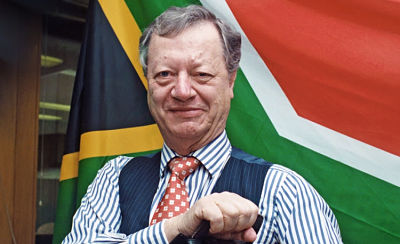
The FW de Klerk Foundation has with sadness taken note of the news that former business leader and Cabinet member, Derek Keys, has passed away. Having played an outstanding role in our transition to democracy, he served in both the Cabinets of former President FW de Klerk and President Nelson Mandela. In his response to the death of Mr Keys, former President De Klerk said: “He was a remarkable man who served South Africa in an exemplary manner. He deserves special respect regarding his work during the Constitutional negotiations. We have lost a great South African.”
Mr Keys, a respected business leader in his own right and at the time Chairman of the mining house Gencor, became Minister of Finance in 1992 and served until September 1994, the latter part in the first Cabinet of the new South Africa. After his political career, he continued to serve on the boards of several companies.
The peaceful resolution of South Africa’s long-standing racial imbroglio 24 years ago seemed to show that even the most intractable disputes could be solved peacefully by compromise and negotiation. Our experience gave new hope to the world that it might be possible to mediate the impossible and that other long-standing disputes might also be resolved through peaceful negotiations.
Not since the dawn of democracy in 1994 have South Africans wrestled with the country we do not want, nor agreed so enthusiastically about the necessity for the restoration of political and social cohesion.

A first national dialogue on land reform took place at the end of March in Johannesburg at the request of the ANC members of the Parliamentary Review Committee. This was ostensibly an attempt by the Ramaphosa faction within the ANC to wrest ownership of the process from the EFF (and Zuma supporters), who had of late been setting the pace in the debate.
The pronouncements of ANC officials at the dialogue brought some interesting and important issues to light. A key issue is that of how the officially-documented Nasrec decision on land reform differs from that which was reported in the media after the elective conference.
While expropriation without compensation (EWC) would be one of the key mechanisms for land reform (as part of radical socio-economic transformation), it was emphasised that its implementation should ensure that future investment in the economy is not undermined (my emphasis),and that agricultural production and food security are not harmed. Implementation should also not harm other sectors of the economy (my emphasis). Further, there should be a focus on land owned by the State, especially abandoned, unused and underutilised land (not necessarily agricultural land). The conditions for EWC in the official Nasrec decision are clearly stronger than initially reported. They are even more powerful when compared with the hastily compiled, sloppily-worded amendment to the EFF parliamentary motion regarding the changes to section 25. This only makes mention of implementation which “increases agricultural production and improves food security”.

What is ‘expropriation without compensation’ (EWC), where does it come from – and what are its implications?
To start with, EWC makes no sense.