Support the work of the FW de Klerk Foundation
For more information regarding donations contact info@fwdeklerk.org or scan the QR code below
LOCAL GOVERNMENT IS FAILING SOUTH AFRICANS – HERE IS HOW WE FIX IT
Issued by Daniela Ellerbeck on behalf of the FW de Klerk Foundation on 02/06/2026
Introduction
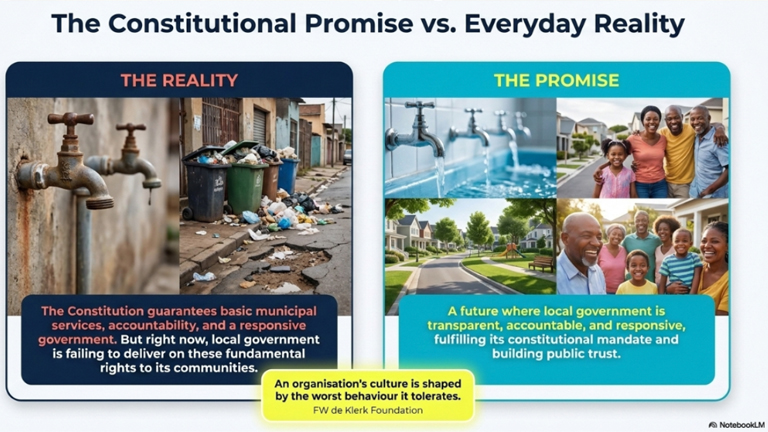
For millions of South Africans, the Constitution promises open, accountable and responsive government, dignity, equality and access to basic services like water. Yet for many communities, those promise collapses at local government level. Water taps run dry, refuse is not collected, potholes are permanent and corruption goes unpunished.
This is not because South Africa lacks good laws. It is because the laws are being ignored. An organisation’s culture is shaped by the worst behaviour it tolerates. The current crisis in local government may be framed as a failure to internalise and enforce the Constitution’s basic values and principles governing public administration.
The FW de Klerk Foundation recently made a submission on the Reviewed Draft White Paper on Local Government. The Foundation’s recommendations focus on structural reform, digital transparency, and professional accountability.
The top five recommendations are as follows:
2. Personal Civil Liability and Criminal Charges: Officials and councillors responsible for unauthorised, irregular, or wasteful expenditure must be sued in their personal capacity. Those involved in crimes, must be charged criminally, rather than relying solely on internal disciplinary processes.
3. Specific Educational Prerequisites for Senior Staff: All senior and permanent public service positions should be required to hold a university qualification in municipal management.
4. Alternative Coalition Threshold: Instead of requiring parties to meet a 1% threshold to win seats on a municipal council, the Foundation suggests a coalition threshold. Small parties should still be allowed to enter the council, but a minimum threshold should apply to them when they want to be part of a governing coalition.
5. Physical Verification by Ward Committees: To ensure the data on the online portal is accurate, the Foundation recommends that ward committees should be the first step in checking if a municipality’s claims are true. For example, if a municipality says all potholes are fixed, ward committees can confirm this during community meetings. Residents should then be able to see that their feedback has been recorded on the online system.
A Single Integrated Online Portal
Local government in South Africa is failing, in a large part, because it operates in the dark: Information is scattered, reports are late or inaccessible and ordinary residents struggle to understand who is responsible for what. This confusion creates space for inefficiency, corruption, blame‑shifting and allows the lack of consequence management.
The Constitution demands open, accountable and responsive government. Yet many municipalities fall short, because poor performance and misconduct continue without real consequences. Over time, this has created a toxic culture where competence is treated as a threat, not an asset.
The single, integrated, public online portal for all municipalities would bring together everything residents and oversight bodies need to know – in one place, in plain language and it would be accessible without data (zero‑rated).
At the centre of this system would be a public dashboard showing:
- What each municipality is responsible for.
- What it has planned to do.
- What it is spending on what.
- What it has delivered.
- Where it is falling behind.
- Its audit outcomes and compliance with deadlines.
In short, it will show who must do what, by when, and whether they did it.
From secrecy to real accountability
The proposed portal would allow:
- Real‑time tracking of procurement processes, from the start of a tender to the final decision.
- A single place to report suspected corruption or maladministration.
- Public tracking of whether reports are investigated and resolved.
- Visibility of outcomes, including disciplinary action or criminal convictions, where legally appropriate.
By removing discretion and shining light on every stage of decision‑making, the system makes it much harder for wrongdoing to be ignored or buried.
Conclusion
The portal is not only about oversight. It is also about empowering communities to hold those in power to account.
The Constitution is not meant to live only in court judgments and policy documents. It is meant to shape everyday life. By creating a clear, transparent and accountable local government system, South Africa can begin to restore trust, professionalise administration and ensure that constitutional rights are experienced where they matter most – at ground level in communities.
SUBMISSION DRAFT GENERAL PUBLIC PROCUREMENT REGULATIONS, 2026
The FW de Klerk Foundation’s submission on Draft General Public Procurement Regulations, 2026
SUBMISSION ON DRAFT TOWNSHIP & RURAL ECONOMY DEVELOPMENT & REVITALISATION POLICY
The FW de Klerk Foundation’s submission on Draft Township & Rural Economy Development & Revitalisation Policy

PUBLIC LAND IS A CONSTITUTIONAL INSTRUMENT, NOT A BALANCE-SHEET ENTRY
The Constitutional Court’s Tafelberg judgment confirms that well-located public land cannot be treated merely as a commercial asset when it can help reverse apartheid’s spatial legacy. Where affordable housing is built matters, because access to employment, transport, education and essential services forms part of meaningful access to adequate housing. Municipalities and provinces must therefore manage and dispose of public land transparently, with genuine public participation and proper regard for its constitutional value.