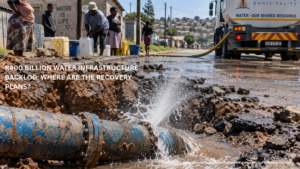
South Africa’s municipal crisis is explained from the bottom up. Residents do not pay. Billing systems fail. Councils approve unfunded budgets. Officials mismanage revenue and infrastructure deteriorates. That is all very real. But Finance Minister Enoch Godongwana’s recent warning exposes another part of the crisis: provincial governments are consuming municipal services, failing to pay for them and leaving municipalities to absorb the damage.
By December 2025, provincial departments owed municipalities R14,9 billion for property rates, water, electricity and sanitation. R8,5 billion, or 57%, had been outstanding for over a year. KwaZulu-Natal and the Free State carried the largest balances. Godongwana has described this as an institutionalised culture of non-payment and has informed Parliament that Treasury intends to invoke section 216(2) of the Constitution against provinces that remain persistently non-compliant. In practice, that would mean withholding part or all of their equitable-share transfers until the breach is remedied.
That matters because municipalities are not merely suppliers and provinces are not merely customers. A municipality must keep water, electricity, refuse collection and sanitation functioning whether a provincial department pays or not. It still faces bulk-service bills, salaries, maintenance costs and obligations to communities. Provincial arrears therefore transfer financial pressure from a larger sphere of government to the smallest and most exposed one.
The constitutional position is straightforward. Sections 40 and 41 describe the three spheres of government as distinctive, interdependent and interrelated and require them to assist and support one another in mutual trust and good faith. Section 154 requires national and provincial government to support and strengthen municipal capacity. Section 151(4) prohibits either sphere from compromising or impeding a municipality’s ability to perform its functions. A province that repeatedly uses municipal services without paying is not supporting local government. It is weakening it.
The Public Finance Management Act of 1999 (“PFMA”) is equally clear. Section 38(1)(f) requires accounting officers to settle contractual obligations and all money owing, including intergovernmental claims, within the prescribed or agreed period. Persistent non-payment is therefore not merely poor administration or an unfortunate cash-flow problem. It raises a serious question of statutory compliance and, where the failure is wilful or negligent, financial misconduct and disciplinary accountability.
Municipalities, meanwhile, are legally required to collect what is owed to them. The Municipal Systems Act of 2000 obliges them to maintain credit-control and debt-collection systems and to provide services on a financially sustainable basis. Government cannot credibly demand that municipalities enforce payment against households and businesses while provincial departments treat municipal accounts as optional. Accountability cannot operate only downwards.
The scale of the imbalance makes the problem worse. The 2026 Budget allocates provinces R670,3 billion in equitable share and R140,2 billion in conditional grants. Local government receives R182,3 billion in direct transfers, including R110,1 billion in equitable share. Provinces have access to a larger fiscal base, yet municipalities are forced to finance provincial operations through unpaid accounts. For provinces, delayed payment may be an internal budget problem. For municipalities, it can mean deferred maintenance, disrupted services and deeper financial distress.
In an election year, that contradiction also matters politically: provincial leaders cannot promise to repair local government while their own departments directly weaken it financially.
There is also no need to romanticise local government to make this argument. National Treasury records 88 municipalities with unfunded budgets, 29 under mandatory financial recovery plans and R236,3 billion in unauthorised, irregular, fruitless and wasteful expenditure in 2023/24. Municipal failure is extensive and often self-inflicted, yes. But provincial non-payment does not correct municipal mismanagement. It compounds it. A municipality already struggling to collect revenue is harmed more, not less, when government itself becomes a delinquent debtor.
Treasury’s proposed use of section 216 is therefore justified. The Constitution permits Treasury to stop transfers where an organ of state commits a serious or persistent material breach of prescribed financial measures. Importantly, that power should not be understood only as an instrument used against municipalities. It can also protect municipalities from financial misconduct elsewhere in the state.
Still, withholding an entire provincial transfer must be handled carefully because provincial budgets fund schools, hospitals and other essential services. The better long-term solution is a targeted mechanism under which verified and undisputed municipal debts are deducted from future provincial allocations and paid directly to the affected municipality, after due process. Treasury has already announced the principle of deducting money owed by departments. It should now formalise it through clear rules, transparent verification and enforceable timelines.
That should be accompanied by monthly publication of departmental municipal debt, broken down by province, municipality and age. Accounting officers responsible for persistent and unjustified arrears should face the consequences already contemplated by the PFMA. Parliament, particularly the NCOP and its finance structures, should require repayment plans, monitor compliance and insist that warnings translate into measurable payments.
The central point is simple. Municipal collapse is not always produced inside municipal boundaries. Sometimes it is manufactured higher up by organs of state that demand financial discipline from local government while refusing to practise it themselves. South Africa cannot keep promising developmental local government while requiring municipalities to provide the province with an interest-free line of credit.
A province that does not pay a municipality is not merely failing as a customer. It is failing as a constitutional partner. Treasury should enforce that distinction now.
For more on this topic read: Local Government Is Failing South Africans – Here Is How We Fix It: https://fwdeklerk.org/local-government-is-failing-south-africans-here-is-how-we-fix-it/