I have a confession to make. A few months ago, someone asked me – a 26-year-old who works daily on constitutional democracy, who can cite Chapter 7 of the Constitution from memory, who genuinely believes local government is the most consequential sphere of our democratic architecture – who my ward councillor was. I went quiet. I did not know.
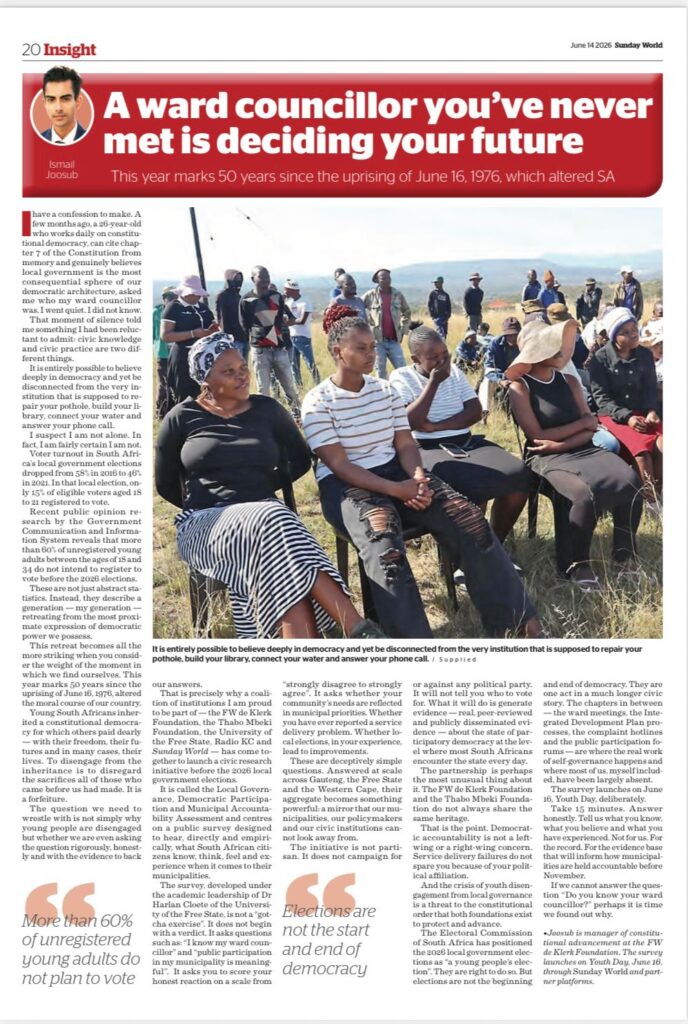
That moment of silence told me something I had been reluctant to admit: that civic knowledge and civic practice are two very different things. That it is entirely possible to believe deeply in democracy and yet to be disconnected from the very institution that is supposed to repair your pothole, build your library, connect your water and answer your phone call.
I suspect I am not alone. In fact, I am fairly certain I am not.
Voter turnout in South Africa’s local government elections has dropped from 58% in 2016 to 46% in 2021. In that last local election, only 15% of eligible voters aged 18 to 21 registered to vote. Now, recent public opinion research by the Government Communication and Information System reveals that more than 60% of unregistered young adults between the ages of 18 and 34 do not intend to register to vote ahead of the 2026 elections. These are not just abstract statistics. Instead, they describe a generation – my generation – retreating from the most proximate expression of democratic power we possess.
This retreat becomes all the more striking when you consider the weight of the moment we find ourselves in. This year marks fifty years since the uprising of 16 June 1976 altered the moral course of our country. Young South Africans inherit a constitutional democracy for which others paid dearly – with their freedom, their futures and in many cases their lives. To disengage from that inheritance is to disregard the sacrifices that all of those who came before us had made. It is a forfeiture. And the question we need to wrestle with is not simply why young people are disengaged, but whether we are even asking that question rigorously, honestly and with the evidence to back our answers.
That is precisely why a coalition of institutions I am proud to be part of – the FW de Klerk Foundation, the Thabo Mbeki Foundation, the University of the Free State, Radio KC and Sunday World – have come together to launch a civic research initiative ahead of the 2026 local government elections. It is called the Local Governance, Democratic Participation and Municipal Accountability Assessment and it centres on a public survey designed to hear, directly and empirically, what South African citizens actually know, think, feel and experience when it comes to their municipalities.
The survey, developed under the academic leadership of Dr Harlan Cloete of the University of the Free State, is not a “gotcha exercise”. It does not begin with a verdict. It asks questions like: “I know my ward councillor” and “Public participation in my municipality is meaningful” and it asks you to score your honest reaction on a scale from strongly disagree to strongly agree. It asks whether your community’s needs are reflected in municipal priorities. Whether you have ever reported a service delivery problem. Whether local elections, in your experience, actually lead to improvements.
These are deceptively simple questions. Answered at scale – across Gauteng, the Free State, the Western Cape – their aggregate becomes something powerful: a mirror that our municipalities, our policymakers and our civic institutions cannot look away from.
I want to be transparent about what this initiative is and what it is not. It is not partisan. It does not campaign for or against any political party. It will not tell you who to vote for. What it will do is generate evidence – real, peer-reviewed, publicly disseminated evidence – about the state of participatory democracy at the level where most South Africans encounter the state every single day.
The partnership itself is perhaps the most unusual thing about it. The FW de Klerk Foundation and the Thabo Mbeki Foundation do not always share the same heritage. That is rather the point. Democratic accountability is not a left-wing or a right-wing concern. Service delivery failures do not spare you because of your political affiliation. And the crisis of youth disengagement from local governance is a threat to the constitutional order that both foundations exist to protect and advance.
The IEC has positioned the 2026 local government elections as “a young people’s election.” I think they are right to do so. But elections are not the beginning and end of democracy. They are one act in a much longer civic story. The chapters in between – the ward meetings, the IDP processes, the complaint hotlines, the public participation forums – are where the real work of self-governance happens and where most of us, myself included, have been largely absent.
The survey launches on 16 June 2026 – Youth Day, deliberately. Take fifteen minutes. Answer honestly. Tell us what you actually know, what you actually believe and what you have actually experienced. Not for us. For the record. For the evidence base that will inform how municipalities are held accountable ahead of November.
Because if we cannot answer the question “do you know your ward councillor?” – perhaps it is time we found out why.
Ismail Joosub is Manager of Constitutional Advancement at the FW de Klerk Foundation. The survey launches on Youth Day, 16 June 2026, through Sunday World and partner platforms.
For more on this topic read: FW DE KLERK FOUNDATION RELEASES “WHOSE RESPONSIBILITY IS IT ANYWAY?” – A NEW DIGITAL GUIDE TO THE 2026 LOCAL GOVERNMENT ELECTIONS – https://fwdeklerk.org/fw-de-klerk-foundation-releases-whose-responsibility-is-it-anyway-a-new-digital-guide-to-the-2026-local-government-elections/