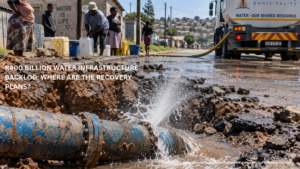
Spending two days in this municipality exposes the stark reality of its collapse. The former heartbeat of the South African economy has been reduced to a dilapidated landscape scarred by massive, neglected potholes and failing public utilities. Residents are left to navigate a complete infrastructural mess, a reality made all the more frustrating by the nearly R700 million that was spent on municipal employee overtime between 2019 and 2025, despite consistently worsening service delivery.
This is the story of the Emfuleni Local Municipality.
Historically the industrial engine of South Africa, it is currently experiencing a catastrophic economic contraction driven by profound administrative and infrastructural dysfunction. A careful analysis of the physical environment reveals a logistical network in absolute ruins, functioning as a massive tax on regional commerce.
The road network is heavily scarred by deep, cavernous potholes that expose the underlying dirt sub-base. The accumulation of dry grass and debris within these craters indicates long-term, systemic neglect from the municipality’s maintenance departments. This total failure of surface infrastructure, characterized by crumbling asphalt and dilapidated curbs, is highly visible even outside modern, secure commercial compounds, showcasing a stark contrast between private investment and public collapse.
For the regional economy, these ruined logistics corridors inflate transit times, damage commercial transport vehicles, and effectively erase the prerequisites required to attract industrial operations.
Furthermore, the daily pedestrian and commercial environments have become demonstrably hazardous, severely impacting local retail economies. Critical intersections feature leaning, non-functional traffic signal poles and unkempt sidewalks situated directly adjacent to operational commercial infrastructure.
Only five refuse trucks were operational across 45 wards, leaving most areas without weekly collection. Sewage spills into streets and rivers are routine. The Auditor-General reports R7 billion in irregular, unauthorised, and wasteful spending.
This underscores the intense operational pressures placed on local businesses attempting to function amidst absolute civic abandonment. Compounding the economic deterrent is the acute threat to public safety; severely leaning non-functioning streetlights with dangling, exposed electrical wires hang precariously over public areas. These hazards pose a significant danger to student foot traffic and significantly degrade the commercial viability of urban centers.
The most devastating macroeconomic impact of this infrastructural decay is the rapid deindustrialization of the Vaal Triangle. The closure of the ArcelorMittal Vereeniging steelworks at the end of December 2025 serves as ground zero for this crisis, directly eliminating approximately 3,500 jobs. While global pressures played a role, the closure was accelerated by failing municipal infrastructure and an eroding technical skills base.
The downstream supply chain devastation was immediate. Following the closure, local businesses dependent on the steelworks’ workforce suffered immense losses; a Vanderbijlpark pharmacy with a strong middle-class customer base saw its business plummet by 30%, while a local egg wholesaler heavily reliant on township retailers recorded his worst single month of business to date.
For small and medium enterprises (SMEs), the cost of mitigating Emfuleni’s municipal failures is crippling. Since the beginning of 2026, an average of 36 businesses per month have been forced into formal liquidation within the municipality due to consistent governance and service delivery failures.
Surviving enterprises are compelled to divert massive amounts of capital toward off-grid survival mechanisms. For instance, Freedom Paper, a local toilet paper manufacturer operating continuously, was forced to implement a high-cost, utility-scale solar energy system after facing a complete municipal power outage lasting two weeks. This forced diversion of capital from business expansion and employment generation into basic utility replacement fundamentally stifles regional economic growth.
Beyond manufacturing, the municipality’s failure to maintain its wastewater infrastructure has triggered an ecological disaster that is decimating the local tourism and agricultural sectors. The daily discharge of millions of litters of raw sewage into the Vaal River system has caused hyper-eutrophication, destroyed riverfront property values and crippled the hospitality industry.
Furthermore, the pathogenic contamination poses a severe threat to South African agriculture. The Klip River alone receives an estimated 260 million litters of effluent from failing sewage works every single day, contaminating downstream irrigation water with dangerous strains of E. coli. Because farmers rely heavily on these water sources, this contamination threatens to trigger devastating international export bans, placing South Africa’s $13.2 billion agricultural export industry at severe risk.
The ultimate economic toll of this multi-vector collapse is the complete unravelling of the local social fabric. With the official unemployment rate in Emfuleni surging to an estimated 56.2%, and youth unemployment exceeding a catastrophic 60%, communities have been plunged into deep, systemic poverty.
High unemployment and desperation have caused local crime levels to skyrocket, with criminals actively targeting the remaining municipal infrastructure for cable theft, further destabilizing the business environment. Ultimately, the dysfunction of the Emfuleni Local Municipality has transformed a once-thriving industrial hub into a landscape of terminal economic decline.