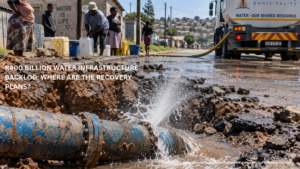
South Africans have grown accustomed to speaking of local government as though collapse were a weather system: pervasive, regrettable and beyond human control. The pothole widens, the tap runs dry, the sewage spill returns and another recovery plan is announced. We complain, but too often the discussion ends there. The FW de Klerk Foundation’s new Local Government Report Card 2026 begins from a more useful premise – that municipal failure is neither mysterious nor inevitable. Its causes can be identified and its remedies measured.
That is the report’s central argument and, indeed, its reason for being. Chapter 7 of the Constitution requires democratic and accountable government, sustainable services, development, a safe and healthy environment and meaningful community involvement. A municipality is where constitutional promises become ordinary experience: water, electricity, refuse removal, roads, public spaces and an administration that answers when citizens speak.
The report asks a question: how well are municipal institutions meeting that standard? It assesses all eight metros and a purposive, stratified sample of 42 local municipalities across all nine provinces. This is a case-study sample, not a national census. It does not rank political parties or presume that today’s mayor caused yesterday’s failure. Its subject is the institution – council, executive, administration and oversight – and its evidence comes from audited reports, National Treasury’s municipal finance data, regulatory findings and municipal records.
Each municipality is tested against 100 questions. Thirty points concern services and infrastructure, 25 financial management and 15 each governance, integrity and constitutional inclusion. Every test earns one point, half a point or none; the total determines the grade. Direction – improving, stable or deteriorating – is recorded because a distressed municipality may be recovering while a highly rated one loses ground. Plans receive credit as plans. Outcomes require proof.
The picture is sobering, but not simplistic. The sample average is 57.4 out of 100 and the median 55.5. Eighteen municipalities are improving, 16 are stable and 16 are deteriorating. Three receive an A, five an A- and five an F. Between them sits a vulnerable middle: municipalities that still function, sometimes impressively, but carry serious financial, infrastructural or administrative risks.
Swartland leads the sample with 90, followed by George at 87.5 and Stellenbosch at 86. Midvaal, uMhlathuze, Kouga, uMngeni and Cape Town complete the top eight. They are not problem-free: housing backlogs, spatial inequality, water pressure and environmental risks remain. What distinguishes them is less glamour than discipline – funded budgets, stronger collections, professional leadership, functioning oversight, maintained assets and completed projects.
At the bottom, Maluti-a-Phofung scores 24, below Renosterberg, Makana, Emfuleni and Matjhabeng. Here failure is cumulative. Weak billing reduces cash; cash shortages delay creditors and maintenance; neglected infrastructure increases losses; poor services weaken public trust and payment; unstable leadership then frustrates recovery. The Auditor-General’s 2024/25 municipal findings reveal the challenge: only 39 of 257 municipalities achieved clean audits. Yet an audit opinion alone cannot tell a resident whether the water is safe or the street passable.
Perhaps the most uncomfortable finding is that scale and wealth offer no immunity. Johannesburg, South Africa’s largest municipal economy, receives 49.5 and a deteriorating D+. Cape Town receives 81 and an A-, but loses points for unequal sanitation, safety, transport and service reliability. Smaller and rural municipalities work with thin revenue bases and dispersed settlements, yet Mbhashe scores 71 and uMhlabuyalingana 68; both are improving. Context changes the difficulty of the task. It does not reduce the resident’s constitutional entitlement.
Nor should a high score become an alibi for complacency. Even the strongest municipality remains constitutionally unfinished if an informal settlement lives with unsafe sanitation, farmworkers remain excluded from housing or participation occurs on paper without influencing priorities. The report treats inclusion not as a decorative chapter, but as a pillar of performance. Competence must be felt across wards, settlements and income levels, or it is incomplete.
What, then, is to be done? The recommendations are practical: protect infrastructure through preventive maintenance; rebuild the chain from metering and billing to collections and indigent support; appoint capable senior officials permanently; turn audit findings into completed correction and real consequences; publish information by default; target spatial and environmental inequality; tailor support to the actual constraint; and track recovery through dated, public measures. These are not dazzling ideas. That is their strength. Municipal government is restored through habits of competence repeated until they become institutional culture.
The Local Government Report Card 2026 is neither a catalogue of despair nor a partisan league table dressed as research. It invites us to judge public institutions with greater precision. Residents can ask better questions; journalists can test claims; councils can locate failure; officials can learn from credible peers; and other spheres of government can target support where it may work.
South Africa simply does not lack proof that functional local government is possible. It exists, unevenly but unmistakably, in municipalities governed under the same Constitution. The challenge before us is to make sound administration ordinary, failure visible and recovery verifiable. A report card cannot repair a pipe. It can make it much harder for those responsible to pretend that nobody knows why it broke.
For more on this topic read: Press Statement on Local Government Report Card
ENDS