

Support the work of the FW de Klerk Foundation
For more information regarding donations contact info@fwdeklerk.org or scan the QR code below
GBV DECLARED A NATIONAL DISASTER: WHAT HAPPENS NOW?
Issued by Ismail Joosub on behalf of the FW de Klerk Foundation on 04/12/2025
President Cyril Ramaphosa’s announcement that gender-based violence and femicide (“GBVF”) now constitute a national disaster marks a moment of national reckoning. For years, South Africans have pleaded for the government to treat this epidemic with the same urgency reserved for floods, pandemics and fires. Now, for the first time, the language of disaster management has been summoned to confront a scourge that tears through families, communities and the constitutional fabric that binds this nation. But declarations, however historic, are only promises in the wind unless matched by lawful, coordinated and measurable action. The question South Africans must ask – calmly, firmly and without illusion – is what legally happens next.
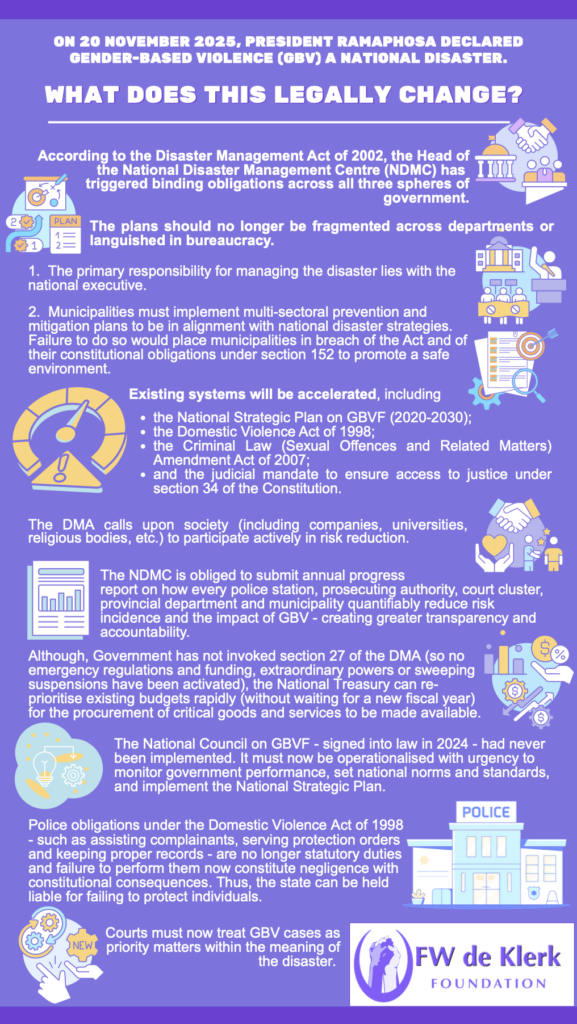
This designation is not a symbolic flourish, because, by classifying GBVF as a national disaster in terms of section 23(1)(b) of the Disaster Management Act of 2002 (“DMA”), the Head of the National Disaster Management Centre (“NDMC”) has triggered binding obligations across all three spheres of government. Unlike the President’s earlier references to a “national crisis”, the legal effect of a national-disaster classification is decisive: section 26 now places primary responsibility for managing the disaster squarely on the national executive. In plain terms, the Cabinet becomes the command centre of the GBV response, constitutionally bound – through section 7(2) of the Constitution – to “respect, protect, promote and fulfil” the rights in the Bill of Rights, including the right to life (section 11), dignity (section 10), equality (section 9) and freedom from all forms of violence, public or private (section 12(1)(c)). Where previous plans fragmented across departments or languished in bureaucracy, the law now demands coordinated national action.
Crucially and unlike the state of disaster declared during Covid-19, the Government has not invoked section 27 of the DMA. No emergency regulations, extraordinary powers, or sweeping suspensions of normal law have been activated.Instead, government has opted for a classification without a full state of disaster, meaning that the legal focus shifts to accelerating the systems that already exist: the National Strategic Plan on GBVF (2020-2030), policing obligations under the Domestic Violence Act of 1998, prosecutorial duties in terms of the Criminal Law (Sexual Offences and Related Matters) Amendment Act of 2007 and the judicial mandate to ensure access to justice under section 34 of the Constitution. Far from being a weaker option, this approach forces the State to use its existing legal arsenal – no shortcuts, no excuses, no waiting for new regulations. It demands implementation, not improvisation.
Section 24 of the DMA obliges the NDMC to submit annual progress reports to the Executive (a designated Minister in Cabinet). For the first time, the fight against GBV carries a statutory reporting duty that cannot be brushed aside by administrative discretion or political comfort. Every police station, prosecuting authority, court cluster, provincial department and municipality must show – through quantifiable actions – how they are reducing the risk, incidence and impact of GBV. This reporting architecture opens the door to the kind of oversight South Africans have long demanded. It creates a written record upon which parliamentary committees, Chapter 9 institutions, courts and the public can hold the government to account. In disaster management terms, this becomes our national “situation report” – one that will either reveal progress or expose neglect.
Section 22 of the DMA, which calls upon society to participate actively in risk reduction, expands the reach of the declaration beyond the State itself. While not legally enforceable against individuals, it carries moral and political weight: private companies, universities, traditional leaders, religious bodies and civil-society organisations are now explicitly called upon to strengthen prevention, education and early-warning systems. Although the Constitution does not vest legal duties directly on private citizens to prevent GBV, the disaster framework allows the State to coordinate multi-sectoral campaigns with unprecedented authority. The law cannot legislate societal conscience, but it can marshal national cooperation when the stakes demand collective responsibility.
One of the most pressing questions is whether this declaration unleashes new funding. The answer lies in the interplay between the DMA, the Public Finance Management Act of 1999 (“PFMA”) and budgetary discretion. A classification alone does not automatically open the taps of emergency funding; that power rests with section 27(2) and has not been activated. But the classification does allow National Treasury to re-prioritise existing budgets more rapidly, to ring-fence allocations without waiting for a new fiscal year and to approve expedited procurement for critical goods and services – rape kits, forensic-lab upgrades, vehicles for Family Violence units, shelter subsidies and personnel for Sexual Offences Courts. The Treasury has already signalled this shift by approving dedicated funding for the National Council on GBVF under the National Council on GBVF Act of 2024 and the first R5 million for its secretariat. If the February 2026 Budget does not reflect this new priority in rands and cents, then the declaration risks becoming a hollow gesture. In financial terms, a national disaster demands extraordinary focus, not extraordinary funds; it rearranges priorities rather than printing new money.
The declaration should also accelerate institutions that have suffered from bureaucratic paralysis. The National Council on GBVF – signed into law in 2024 but never implemented – must now be operationalised with urgency. Its mandate under section 4 of the Act includes monitoring government performance, setting national norms and standards, and ensuring implementation of the National Strategic Plan. Delay is no longer legally or morally defensible. A country cannot fight a national disaster without its central command system in place. Treasury’s approval of ring-fenced funding and nominations for the Council’s Board is welcome, but insufficient until the Council is staffed, capacitated and empowered to demand accountability.
The criminal-justice system must also adjust under this new legal landscape. Police obligations under the Domestic Violence Act of 1998 – such as assisting complainants, serving protection orders and keeping proper records – are no longer just statutory duties and failure to perform them in the midst of a declared disaster may now constitute negligence with constitutional consequences. The Constitutional Court’s landmark decision in Carmichele v Minister of Safety and Security makes clear that the State can be held liable for failing to protect individuals from known threats. Under the disaster framework, this principle becomes even sharper. If a police officer refuses to open a domestic-violence case, fails to enforce a protection order, or negligently releases a repeat offender, civil claims for constitutional damages – anchored in sections 12 and 7(2) – become more likely, not less. Disaster classification tightens, rather than loosens, the obligations of law-enforcement officers.
Equally, the courts must now treat GBV cases as priority matters within the meaning of the disaster. While the judiciary cannot be instructed by the executive, the disaster framework creates an enabling context for the Chief Justice and the Minister of Justice to expand Sexual Offences Courts, appoint additional prosecutors, extend court hours and clear case backlogs. Section 165 of the Constitution protects judicial independence, but it does not prevent administrative adjustments that improve access to justice. The urgency of disaster management should guide resource allocation within the judiciary without compromising independence, but without tolerating delays that carry life-and-death consequences.
Local government, often overlooked in national GBV debates, now has explicit responsibilities under the DMA. Municipalities must implement multi-sectoral prevention and mitigation plans like improving street lighting, ensuring safe public transport routes and strengthening by-law enforcement in crime hotspots and coordinating with police and social-development departments. The DMA requires alignment of municipal plans with national disaster strategies, meaning that Integrated Development Plans (“IDPs”) and municipal budgets must reflect GBV as a risk. Failure to do so would place municipalities in breach of the Act and of their constitutional obligations under section 152 to promote a safe environment.
Ultimately, the success of this declaration depends not on the poetry of presidential speeches, but on the prose of implementation. Declaring a national disaster does not magically reverse decades of under-funding, weak coordination and unfulfilled promises. But it does change the legal terrain. It creates reporting duties where none existed, assigns national executive responsibility where blame was once diffused, accelerates funding where delays were once routine and strengthens the constitutional duty to protect women and children from violence. It is not a shortcut, if anything, it is a sharpening of accountability. And, like all moments of reckoning, it offers no comfort except the truth.
South Africans must now watch closely. If the declaration leads to more shelter beds, faster forensic processing, better-trained police, functional Sexual Offences Courts and a fully operational National GBVF Council, then history will remember this moment as the beginning of the end of our country’s most enduring nightmare. But if the declaration fades into the background noise of previous action plans and forgotten promises, then we risk not only constitutional failure, but moral failure. A nation that cannot protect its women and children cannot claim to be free.
The Government has declared a disaster. The law has drawn the circle of obligation. What happens now will determine whether this declaration becomes a turning point or another missed opportunity in a country that has already buried far too many dreams in silence.