

Support the work of the FW de Klerk Foundation
For more information regarding donations contact info@fwdeklerk.org or scan the QR code below
END THE SIEGE: RECLAIMING COMMUNITIES HELD HOSTAGE BY GANGS
Issued by Ismail Joosub on behalf of the FW de Klerk Foundation on 06/11/2025
When six people were gunned down in a drive-by shooting in Reiger Park, moments after the funeral of a slain gangster, it was not an isolated tragedy but the inevitable consequence of a system that has allowed gangsterism to metastasize from the Cape Flats to Eldorado Park and beyond. The massacre unfolded in the heart of a residential neighbourhood, where families were still gathered in mourning and gunmen sprayed bullets indiscriminately from a speeding vehicle. It was a chilling reminder of how deeply the culture of retaliation has taken root – funerals turning into battlegrounds, grief immediately followed by more grief. Police cordoned off the street, briefed the media and moved on. The community buried its dead and braced for the next reprisal. This is not ordinary crime; it is a systemic collapse that denies South Africans – particularly those in coloured communities – the constitutional guarantees of life, safety and dignity.
To understand the violence of today, one must confront the history that shaped it. Apartheid’s forced removals uprooted families from stable, mixed suburbs and exiled them to the barren peripheries of cities. The Cape Flats were designed as dumping grounds, not neighbourhoods. Schools and churches that once anchored communities were hollowed out, jobs moved far away and in the vacuum, gangs became surrogate employers, “protectors” and, ultimately, shadow governments. Three decades into democracy, that legacy persists. Geographic isolation, unemployment and the collapse of social infrastructure have left generations stranded in the margins, where gangsterism offers belonging, income and a perverse form of prestige that feels like the only ladder available.
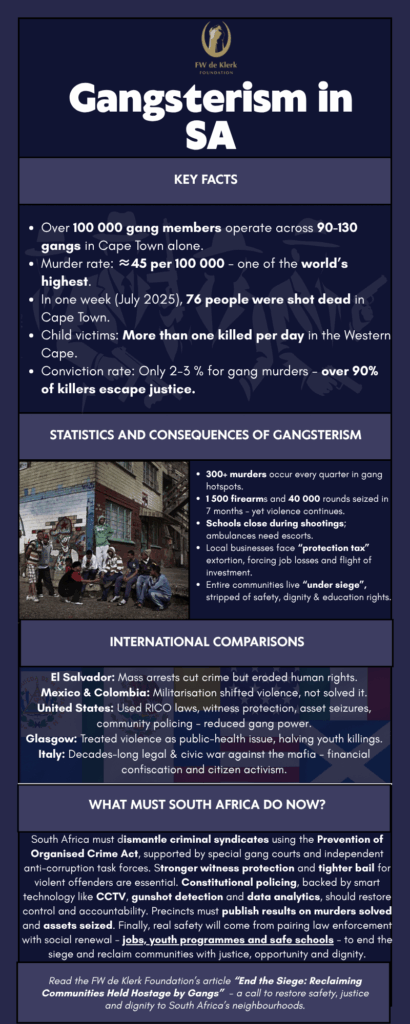
The statistics tell their own story of a nation bleeding out. South Africa’s murder rate hovers around 45 per 100 000 people. In just one week in July 2025, 76 people were shot dead in Cape Town alone. Across gang hotspots, nearly 300 murders occur every quarter, with the Cape Flats dominating the nation’s top murder precincts. Children are the most innocent victims – more than one a day is killed in the Western Cape and in just three months of 2024, 79 young lives were lost, many in gang-related incidents. In Cape Town alone, between 90 and 130 gangs operate with a combined 100 000 members. Over seven recent months, police seized more than 1 500 firearms and nearly 40 000 rounds of ammunition, yet convictions for gang murders languish at an abysmal 2%-3% (less than 1% in 2026). In essence, more than 90% of gang killers escape justice.
The violence in Reiger Park is proof that gangsterism no longer belongs to one province or one city. Once caricatured as a Western Cape affliction, it now festers in Gauteng’s Westbury, Eldorado Park and the East Rand, while Nelson Mandela Bay’s northern areas endure the same daily reality of turf wars, extortion and fear.
Officials label these “low-intensity warzones,” but for residents, it is simply abandonment – a life lived under siege, waiting for the next volley of gunfire.
The cost of this crisis cannot be measured in numbers alone. Children flinch instinctively at loud noises, having learned to distinguish gunfire by sound. Teachers suspend lessons when the streets erupt. Ambulances and firefighters require police escorts to reach “red zones”. Local businesses – spaza shops, construction firms, nightclubs – are trapped in protection rackets that have evolved into a shadow tax system. Investment flees, jobs vanish and unemployment feeds recruitment, which fuels more violence. The cycle is efficient, relentless and devastating.
At its core, this is a constitutional emergency. Section 11’s right to life, section 12’s right to be free from violence “from public or private sources,” and section 10’s right to dignity are not theoretical ideals – they are daily casualties in gang-ruled areas. Section 29’s guarantee of education is meaningless when classrooms lie in the crossfire and section 27’s right to health is hollow when paramedics cannot safely enter. Equality before the law under section 9 rings false when coloured communities receive less protection and slower justice. Section 205(3) commands the police to protect inhabitants and section 198 commits the nation to freedom from fear; yet in many townships, that promise lies broken amid bullet casings.
For years, the state’s response has been reactive, not strategic. Military deployments, tactical surges and headline-grabbing operations come and go. Soldiers patrol for a month, arrests spike and then violence resumes once the cameras leave. The Anti-Gang Units and multi-agency task teams are conceptually sound, but they need insulation from politics and a focus on dismantling the upper echelons of gang leadership. Locking up low-level “runners” while bosses still bank profits – and issue orders from prison – changes nothing. Hundreds of arrests and major gun seizures mean little if communities never see the perpetrators of murder actually sentenced.
The roots of gangsterism are intertwined: poverty so entrenched it becomes destiny, a drug economy that provides both income and identity, the easy availability of firearms (many leaked by corrupt officials), investigations that drag for years and corruption that erodes faith in the state. Extortion now functions as a business model, while politics occasionally treats gangsters as patrons or vote brokers. This is how democracies rot from within. As early as 2019, intelligence officials warned that gangsterism could corrode policing, the courts and even the legislature – ushering in a narco-state. Today, that warning feels prophetic.
Other nations’ experiences offer both caution and guidance. El Salvador’s sweeping mass arrests cut homicide rates, but shredded human rights and sustainability. Mexico and Colombia show how militarisation without reform merely shifts the bloodshed. The United States turned the tide through RICO laws, witness protection, asset seizures and deep community policing. Glasgow reframed violence as a public-health epidemic and reduced youth killings through early intervention. Italy waged a decades-long war on the mafia with unflinching prosecutions, financial confiscations and civil movements that refused extortion. Across these examples, one truth stands out: smart, constitutional enforcement paired with social renewal outperforms both heavy-handed crackdowns and empty speeches.
So, What Must South Africa Do Now?
South Africa’s fight against gang violence begins with a disciplined reassertion of the rule of law. Gangs must be treated as organised criminal enterprises under the Prevention of Organised Crime Act of 1998, with prosecutors pursuing racketeering, money-laundering and asset forfeiture relentlessly. Specialised gang courts and stronger bail restrictions for violent offenders should operate alongside an independent task force cleansing police and prisons of corruption, gun leaks and collusion. On the streets, constitutional policing and modern technology must restore control – expanding trained patrols, cutting 10111 response times and using gunshot detection, CCTV and analytics to disrupt hotspots. Transparency matters: precincts should publish quarterly reports on murders solved, assets seized and conviction rates so the public can see accountability in action.
Here lies the bottom line: if a child in Bishop Lavis or Reiger Park cannot walk to school in safety, then the Constitution is not yet real. We already know what has worked elsewhere and what has failed here. The true question is whether we still believe in equal citizenship. If we do, we must act with urgency and discipline – applying lawful force against those who destroy lives and creating relentless opportunity for those who can still be saved. Only then will we reclaim our streets, restore dignity and make constitutional promises tangible.
This country has done hard things before. It defied the odds to negotiate a peaceful transition when many predicted civil war. It can once again summon that courage and common sense to reclaim the Cape Flats, Eldorado Park and Reiger Park. Put the kingpins in the dock, protect the witnesses, drain the gang economy and flood young people with choices better than a gun and a grave. Do that – consistently, constitutionally – and the funerals will slow, the classrooms will fill and the rule of law will finally serve its purpose: to protect the innocent and restrain the violent.
Reclaiming these communities is not charity. It is the overdue fulfillment of the Constitution itself. The lives at stake belong to our neighbours, our fellow citizens and our children. The state must now prove – through results, not rhetoric – that their rights are not negotiable and their future is not forfeited.