

Support the work of the FW de Klerk Foundation
For more information regarding donations contact info@fwdeklerk.org or scan the QR code below
ECONOMIC STAGNATION IN SOUTH AFRICA: HOW TO OVERCOME IT
By Moeletsi Mbeki
A. Natural Resource Curse
I. The World Bank regularly publishes a Global Human Capital Index. The Human Capital Index measures which countries are best at mobilising their Human Capital-the economic and professional potential of their citizens. It thus measures how much capital a country loses through lack of education and health. The top ten countries in a survey of 169 countries in the 2020 Human Capital Index were Singapore, Hong Kong, Japan, Korea, Canada, Finland, Macao, Sweden, Ireland and the Netherlands. South Africa was number 132. Among African countries Mauritius was number 58, Kenya was number 91. The bottom ten countries were all African countries; DRC, Sierre Leone, Angola, Mozambique, Nigeria, Liberia, Mali, Niger, Chad and CAR.
Figure 1
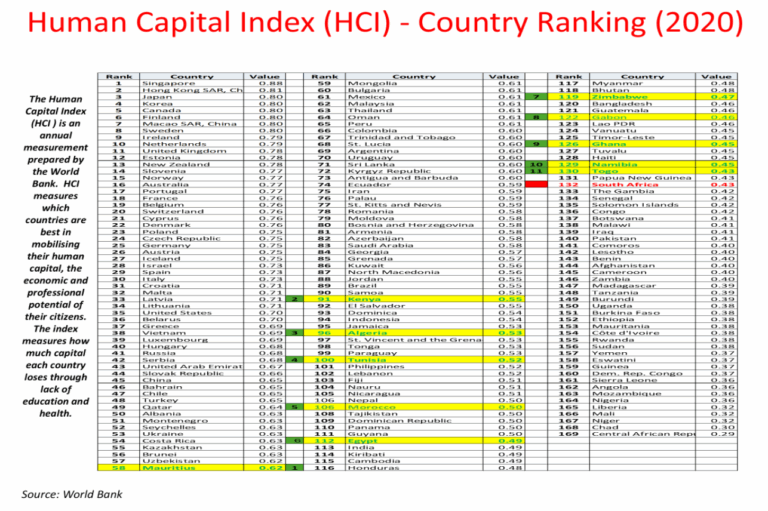
II. Why does South Africa’s economy, the most diversified economy on the African continent, have amongst the lowest Human Capital Index both in Africa and in the world? This is explained in part ironically by South Africa’s vast mineral resource endowment. Large mineral endowment is both a blessing and a curse. South Africa is a classic illustration of this duality. The exploitation of South Africa’s large mineral endowment explains the relative development of its economy; at the same time it explains its stagnation.
III. The South African economy, as we know it today, dates from 170 years ago with the discovery of copper deposits in Namaqualand in 1854. These discoveries were soon followed by the discovery of diamonds, gold, coal and platinum deposits to mention only a few minerals in South Africa’s treasure trove. To extract these minerals South Africa had to import everything except Black labourers. It imported capital, machinery, skilled miners, railways, food and other supplies.
IV. The exploitation of minerals thus created what came to be known as an Enclave Capitalist Economy. This type of an economy employs a relatively small number of workers, most of them unskilled, but produces minerals of very high value in the world market. Such an economy can thus sustain a small enclave population with a fabulous standard of living in a sea of poor, low skilled population. This was what South Africa became during the last 170 years.
Figure 2

Compared to the United States which has a developed capitalist society, South Africa’s middle and upper class/elite is only 12% of the economically active population whereas a similar population group in the United States – proprietors, managers and professionals – are 37.6% of the economically active population. Most striking is South Africa’s size of the category underclass and unemployed. They comprise nearly half of the economically active population of South Africa. This category does not exist in the United States.
Figure 3

V. An Enclave Capitalist Economy in South Africa developed through Imports Substitution Industrialisation. This is in contrast to how the economies in east and south east Asia are developing. They are developing through Export Promotion Industrialisation. This explains why the South African economy is less sophisticated than Asian economies.
Figure 4

An important attribute of a natural resource Enclave Capitalist Economy is its dependence on imported skills and technology. Such an economy is dominated by foreign companies in most sectors especially in manufacturing. This explains its relatively low investment in research and development. Foreign firms carry out their research and development in their home countries. It also explains the dominance of oligopolies in many sectors of the economy. This therefore accounts for low levels of entrepreneurship in such an economy as South Africa’s. The foreign firms carve up the limited, protected domestic market in an Enclave Capitalist Economy and so keep out new entrants into the economy.
VI. A mineral dependent enclave economy lives with enormous risks. Top of the list is what happens when mineral resources become depleted and/or are substituted due to technological changes? We are witnessing this happen in South Africa today in connection with its four top primary export minerals – gold, diamonds, coal, platinum group metals:
- Gold deposits have become more uneconomical to mine due to the depth of the deposits
- Diamonds are being replaced with cheaper synthetic diamonds
- Coal is being phased out due to climate change considerations
- Platinum is being made superfluous by the phasing out of the internal combustion engine which used platinum to scrub exhaust fumes
Figure 5
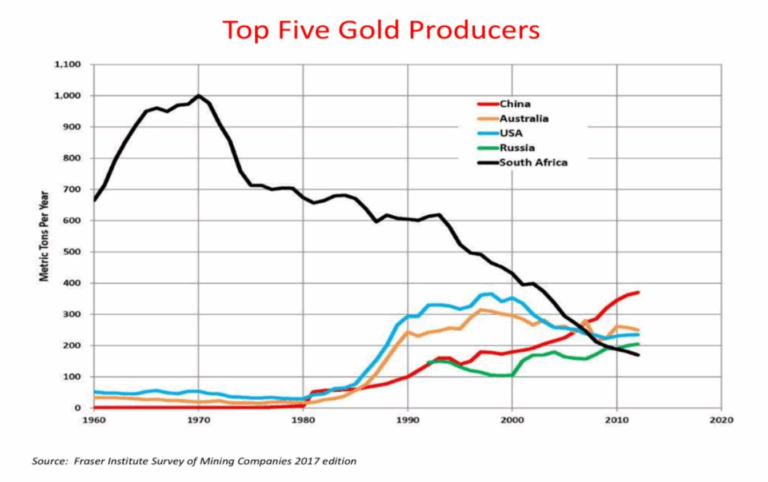
VII. Mineral assets depletion or their substitution is one cause of South Africa’s economic stagnation. The second source of the country’s stagnation is democracy.
B. Democracy, Deindustrialisation and Economic Stagnation
VIII. One of the most important outcomes of democracy in South Africa was it transferred political power from property owners, farmers; miners; factory owners; banks owners; shop owners to non-property owners, the African middle-class professionals. This is one of the major drivers of the country’s economic stagnation.
Non-property owners – African middle-class professionals – who control the state use their political power to transfer the economic surplus from potential investment in the production sector to consumption by the ruling political elite using the tax system and awarding themselves inflated public sector salaries.
Figure 6
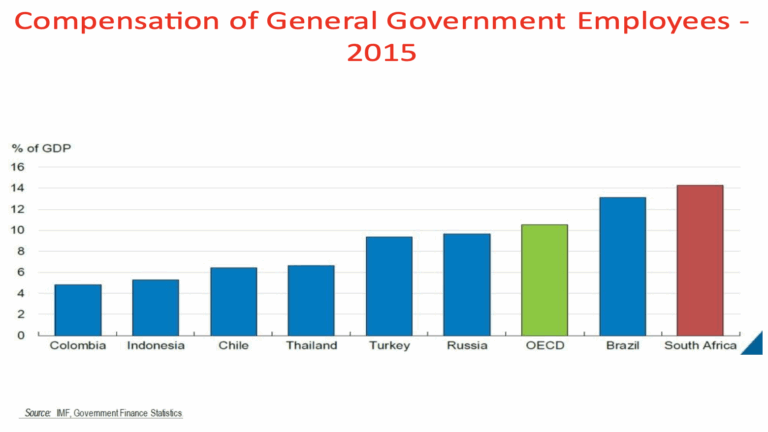
IX. Democracy is a last resort form of appeasing or accommodating the demands of aggrieved social groups through the creation of a more inclusive system of governance. Democracy comes about when the use of force has failed to suppress or overcome threats from below to an existing socio-economic order. Democracy is a mode of preserving, as much as possible, the existing socio-economic order through compromise and accommodation where use of force by protagonists has failed to prevail.
X. I once asked Pik Botha why the National Party (NP) decided to negotiate when it did, from a position of strength. Botha said the National Party estimated it could hold back the threat from the Blacks by force for another 10 years. Botha said a more immediate threat to the regime were the whites. He said the whites were not prepared to sacrifice their standards of living in order to preserve apartheid. The main threat to the white standard of living came from international sanctions especially American sanctions. The British government was also aware of the treat of the collapsing South African economy posed by the American sanctions. By their own calculations, the British concluded a collapsing South African economy would dislocate 800 000 people of British descent from South Africa and another 200 000 citizens in the United Kingdom who would lose their jobs derived from trade with South Africa. Given the threat to South Africa’s socio-economic order, the National Party therefore had to find a formula that preserved as much of the existing socio-economic system as possible by accommodating its adversaries who by the mid-1980s included: big business, Whites, Blacks, American government, United Kingdom government, African governments, United Nations and the Commonwealth.
C. Conclusion – How to Overcome Economic Stagnation
My conclusion is that political power in South Africa today is in the hands of the combined black and white middle-class. Left out of political power are the working class, the poor, and the capitalists. As the middle-class in South Africa is consumption driven, this is a dangerous outcome for South Africa economically. It means economic stagnation is going to continue indefinitely unless a coalition of the marginalised groups intervene politically and form a new coalition to contest for political power on a production driven agenda.
Desirable way forward for South Africa
- Promote conversation between the casualties of the African National Congress (ANC) governance especially the poor, churches and business about a better and inclusive future for South Africa
- Economic modernisation policies to reduce dependence on mineral resources
- Creation and promotion of a new entrepreneurial class linked to digital and 4IR technologies
- Overhaul of the education system to improve South Africa’s Human Capital Index position from 132 out of 169 globally
- Repeal black economic empowerment (BEE) legislation
- Professionalise public service and halve its cost as a percentage of Gross Domestic Product (GDP)
- Draw up an urbanisation plan for South Africa and development strategy for rural areas in former homelands
*Moeletsi Mbeki is chairperson of The South African Institute of International Affairs (SAIIA), an independent think tank based in Johannesburg