Support the work of the FW de Klerk Foundation
For more information regarding donations contact info@fwdeklerk.org or scan the QR code below
ECONOMIC FREEDOM UNDER STRAIN: ACCESS TO WORK IN SOUTH AFRICA
Issued by Daniela Ellerbeck and Lusanda Mahkuntsu on behalf of the FW de Klerk Foundation on 09/04/2026
Introduction
The Constitution guarantees citizens the right to choose their trade, occupation or profession. This is a key part of economic freedom and dignity. However, the FW de Klerk Foundation’s latest Human Rights Report Card rated the enjoyment of this right as poor and deteriorating. Too many South Africans still struggle to find work or access meaningful economic opportunities.
Policy Shifts and Their Impact
The Employment Equity Amendment Act took effect in January 2025. It empowers the Minister of Employment and Labour to set sector-specific targets to improve workplace representation. The aim is to promote equitable representation.
However, concerns about its impact remain. Some argue it may limit hiring and promotion opportunities for certain groups. Others warn of possible skills shortages and slower economic growth. The full impact remains uncertain.
Uncertainty around the National Health Insurance Act (“NHI”), 2023, has also affected the healthcare sector. Although the Act is not yet in operation, concerns about its future impact have raised fears about job security and the possible loss of medical professionals.
Even where skills are available, opportunities are not. In 2025, more than 8 000 healthcare graduates were placed in internships and community service. Yet at least 450 qualified doctors remained unemployed after training. Budget constraints meant that many posts could not be filled.
Labour reforms also changed working conditions. The national minimum wage increased to R28,79 per hour. While this boosted earnings for some, it also sparked concern about employers’ ability to hire more staff.
The 2025 National Minimum Wage Input Report found that minimum wages can limit access for “new entrants” to the labour market. Among domestic workers, 21% reported having lost all employment and another 36% experiencing partial job loss.
Unemployment: The Central Barrier
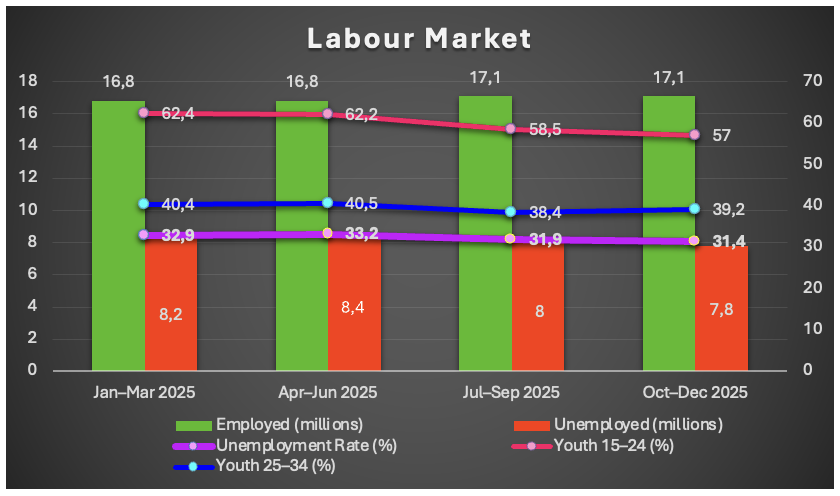
Unemployment remains the greatest obstacle to enjoyment of this right. Although it improvement slightly from 32,9% in early 2025 to 31,4% by the end of 2025, it remain very high.
Youth unemployment is at crisis levels with young people repeatedly hit the hardest with unemployment: More than half of those aged 15 to 24 were unemployed. Nearly 40% of those aged 25 to 34 remain without work.
This locks young people out of the formal economy and limits their future prospects severely.
A Path Forward: Foundation Recommendations
To expand access to work and economic opportunity, the Foundation recommends, among others, the following: Expand Technical and Vocational Education and Training (“TVET”) and link it to paid apprenticeships and internships. Deregulate micro-enterprise zones in township areas to allow young people to start businesses with fewer compliance burdens, encouraging formalisation and job creation. Invest in long-term initiatives that will provide the youth with viable career pathways, not only in trade and industry, but also in emerging sectors such as technology, green energy and innovation. Align education to economic demands. Offer firms tax credits for hiring people under 30. Merge fragmented youth‑employment programmes into one vehicle with clear performance targets. Roll out rental subsidies, or low‑deposit loan guarantees, to help young workers move to where jobs are. Pilot income‑linked education bonds.
Conclusion
The Constitution promises freedom of economic choice. For most South Africans, this freedom remains out of reach. While policy reforms may promote fairness, they cannot substitute for the one ingredient the country needs most: strong, sustained economic growth that creates jobs. Unless this changes, the gap between constitutional promise and lived reality will continue to widen.
SUBMISSION URGENT REQUEST FOR CONFIRMATION OF PARLIAMENT’S TIMELINES, ROADMAP AND INSTITUTIONAL PRIORITIES FOR ERCP REPORT – FOLLOW-UP
Follow-up on The FW de Klerk Foundation’s urgent request for confirmation of Parliament’s timelines, roadmap and institutional priorities for ERCP Report

TAX, QUALITY OF LIFE, AND THE REAL CHALLENGE FACING SOUTH AFRICA
Data from international indices—including the OECD, Eurostat, PwC, and the World Bank—demonstrate that South Africans are subjected to a double financial burden through high taxes and private service costs.

MAY THE CAPE TOWN METROPOLITAN POLICE INVESTIGATE CRIME?
The ongoing crime crisis in South Africa, and particularly in Cape Town, has led to a constructive debate about the role and powers of municipal police services. While the South African Police Service (SAPS) is increasingly struggling to combat organized crime and violence effectively, the City of Cape Town has taken steps to establish its own investigative capacity.