Support the work of the FW de Klerk Foundation
For more information regarding donations contact info@fwdeklerk.org or scan the QR code below
AUDITOR-GENERAL TSAKANI MALULEKE TABLED THE CONSOLIDATED REPORT ON LOCAL GOVERNMENT AUDIT OUTCOMES 2024-25 ON 24 JUNE 2026
Issued by Christo van der Rheede on behalf of the FW de Klerk Foundation on 25/06/2026
Overall State: The 2024-25 Auditor-General report reveals that local government has failed to achieve a turnaround, resulting in unreliable services and failing infrastructure.
Stagnant Outcomes: 57% of municipalities maintained their poor 2020-21 audit outcomes, while 15% regressed.
Rare Clean Audits: Only 15% of municipalities achieved a clean audit, representing a mere 8% of the total expenditure budget.
Failing Metros: None of the metropolitan municipalities achieved a clean audit, despite managing 54% of the total budget and serving 46% of the country’s households.
Severe Financial Distress: 45% of municipalities adopted unfunded budgets, committing to R288.17 billion they do not have.
Flawed Reporting: 76% of municipalities submitted financial statements containing material misstatements.
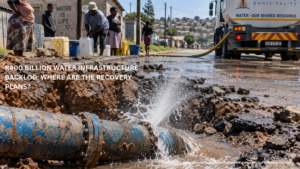
Massive Revenue Losses: Infrastructure neglect caused R14.73 billion in water losses and R21.63 billion in electricity losses.
Irregular Expenditure: Municipalities incurred R145.21 billion in irregular expenditure since 2021-22, driven almost entirely (87%) by procurement and contract non-compliance.
Zero Accountability: Governance failures are pervasive, with councils frequently writing off irregular expenditure instead of investigating fraud indicators or enforcing consequences.
Wasted Consulting Fees: Despite spending R1.61 billion on financial consultants, 61% of those municipalities still submitted flawed financial statements due to severe internal skills gaps.
Free State & North West: Both provinces recorded a 100% rate of material non-compliance across all municipalities. These provinces also struggle with the highest average number of compliance findings.
Financial Distress: North West (59%) and Free State (52%) have the highest percentages of municipalities with “unfavourable” financial health ratings.
Northern Cape: Follows closely with 97% of municipalities reporting material non-compliance findings.
Gauteng: Notable for significant regressions in audit outcomes among its metropolitan municipalities, severely impacting service delivery for a large portion of the population.
Western Cape: Continues to demonstrate the strongest adherence to legislation, while the Free State and North West remain the most critically challenged.
Available at: Audit 2024-25

PUBLIC LAND IS A CONSTITUTIONAL INSTRUMENT, NOT A BALANCE-SHEET ENTRY
The Constitutional Court’s Tafelberg judgment confirms that well-located public land cannot be treated merely as a commercial asset when it can help reverse apartheid’s spatial legacy. Where affordable housing is built matters, because access to employment, transport, education and essential services forms part of meaningful access to adequate housing. Municipalities and provinces must therefore manage and dispose of public land transparently, with genuine public participation and proper regard for its constitutional value.

LESSONS FROM THE 2026 GTAC CONFERENCE
The 2026 GTAC Public Economics Conference highlighted a central truth: South Africa’s employment crisis cannot be solved by training people for jobs that do not exist. Sustainable progress requires evidence-based policy, smarter public spending and greater support for the informal, township and rural economies where millions already earn their livelihoods. Ultimately, the Constitution demands a state that protects dignity, removes barriers to opportunity and measures success by real outcomes rather than the number of programmes funded.

FW DE KLERK FOUNDATION ON WITHHOLDING OF MUNICIPAL TRANSFERS
The FW de Klerk Foundation notes National Treasury’s decision to withhold transfers to non-compliant municipalities and Parliament’s call for their urgent compliance. These developments confirm what has become crystal clear: Many municipalities across South Africa faces a deep and persistent governance crisis.