Why are we suddenly talking about election boundaries?
If you have heard the phrase “alignment phase” being mentioned in recent weeks, you are not alone. South Africa is quietly undergoing one of the most important – and least understood – constitutional processes in the lead-up to the 2026 Local Government Elections: the redrawing and implementation of ward boundaries. On 10 December 2025, the Municipal Demarcation Board (“MDB”) officially handed over the final ward boundary maps to the Independent Electoral Commission (“IEC”). That handover marked the end of a two-year redrawing process and the beginning of the IEC’s work to align over 27 million registered voters with the new maps. What might seem like administrative trivia is actually constitutional housekeeping of the highest order – the careful recalibration of local democracy to ensure that every vote carries equal weight.
Who is the Municipal Demarcation Board (“MDB”) and why does it matter?
The MDB is not a political body. It is an independent authority created by law to determine municipal boundaries and to delimit wards within municipalities. Its independence is constitutionally required. Section 155(3)(b) of the Constitution mandates that municipal boundaries must be determined by an independent authority. Section 157(4)(a) further provides that if a municipal electoral system includes ward representation – as ours does – those ward boundaries must be delimited by an independent body in accordance with national legislation. The MDB derives its legislative mandate primarily from the Local Government: Municipal Demarcation Act of 1998, which establishes the Board and regulates municipal boundary changes and the Local Government: Municipal Structures Act of 1998, particularly Schedule 1, which governs ward delimitation procedures and criteria. In simple terms, the MDB draws the lines. It determines where one municipality ends and another begins and it subdivides municipalities into wards for electoral purposes. And it does so according to strict constitutional principles: fairness, independence and equal representation.
What exactly did the MDB do for 2026?
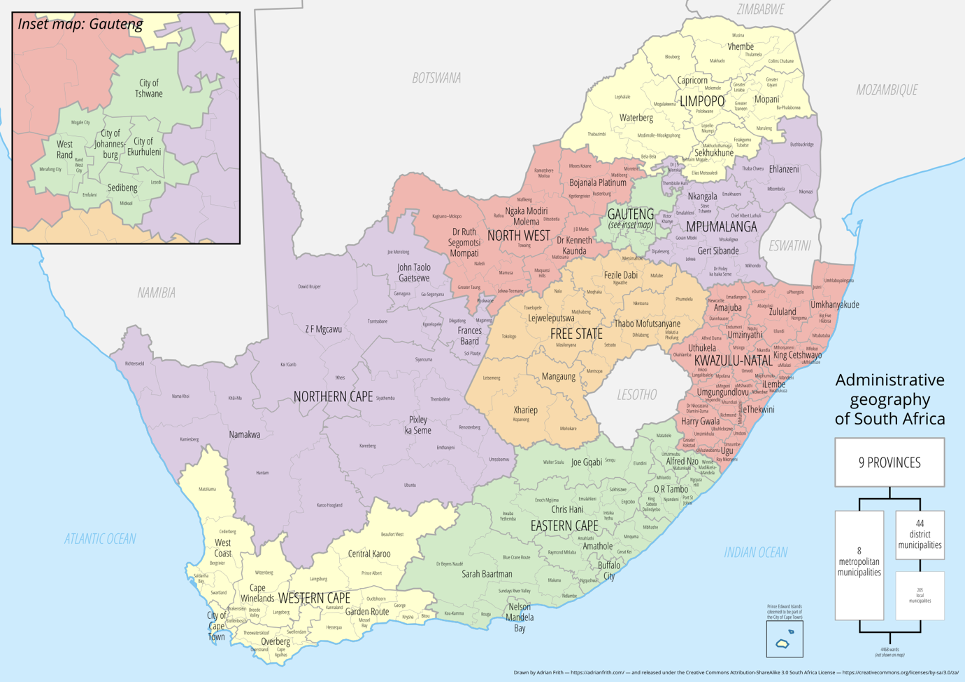
From what we see, the MDB spent 2024 and 2025 reviewing and redrawing ward boundaries across the country in preparation for the next municipal elections. This happens every five years. Why? Because populations shift. People migrate. New housing developments emerge. Natural disasters displace communities. If ward boundaries were left untouched, some councillors would represent far more voters than others – undermining the principle of equal representation. The headline figures are instructive. South Africa had 4 468 wards in 2021. For 2026, that number rises to 4 488 – a net increase of 20 new wards. Almost all 20 new wards are in KwaZulu-Natal, which grew from 901 wards in 2021 to 921 in 2026, largely due to population growth and demographic shifts. Nationally, this is a modest increase of roughly 0,45 percent. But even small adjustments matter, because they recalibrate representation. The MDB also implemented 628 ward boundary line amendments – redrawing internal lines within municipalities to rebalance voter numbers and unify communities. In addition, the MDB made a significant municipal boundary decision by resolving to split the Kopanong Local Municipality in the Free State into two municipalities to improve governance and service delivery. That split will take effect at the 2026 elections.
Why must wards be redrawn before every local election?
The answer lies in one of democracy’s most sacred principles: one person, one vote. Section 1 of the Constitution enshrines universal adult suffrage and a multi-party system of democratic government founded on accountability, responsiveness and openness. Section 159 sets a five-year term for municipal councils, requiring regular elections. To give real effect to equal suffrage, wards must contain roughly similar numbers of registered voters. If one ward has 10 000 voters and another has 25 000, then the weight of each vote differs significantly. The Municipal Structures Act of 1998 requires that wards, at the time of election, have more or less equal numbers of voters. That is why delimitation is not arbitrary, but rather a constitutional safeguard against distortion. The MDB also applies additional criteria. Wards may not cross municipal boundaries. Communities of interest should not be unnecessarily divided. Natural boundaries and geographic coherence should be considered. The number of wards in a municipality must correspond to the total number of councillors allocated, as determined by population formulas set by law. In short, redrawing wards is about keeping democracy balanced and functional.
What happens now that the maps are finalised?
Now the baton passes to the IEC. We are currently in what can accurately be described as the alignment phase. The IEC is reviewing approximately 23 292 voting districts nationwide to ensure that each one falls entirely within a single ward under the new maps. If a voting district was split by a newly drawn ward line, the IEC must redraw or reassign it. This process affects approximately 26 to 27 million registered voters, who must now be matched to the correct ward of ordinary residence. This alignment process is administrative – but it is essential. Without it, voters could arrive at polling stations only to discover they are registered in the wrong ward. The key milestones on the road to 2026 are clear. In early 2026, the IEC began aligning voting districts and updating the voters’ roll. In mid-2026, likely in June and again in August, voter registration weekends will be held. By August 2026, the Minister of Cooperative Governance and Traditional Affairs is expected to proclaim the election date. The Constitution requires that municipal elections be held between 2 November 2026 and 31 January 2027 and it is widely anticipated that the elections will take place in November 2026.
How might these changes affect ordinary voters?
This is where the abstract becomes personal. If your street was moved to a different ward last month, several practical consequences follow. Your ward number may change. Your list of ward candidates will change. Your councillor after 2026 may be different. Your voting station may change. While many voting stations remain physically the same, their ward designation may shift. In some cases, voters will be reassigned to different stations altogether. That is why it will be vital, during the 2026 registration weekends, for voters to check their ward number, their voting district and their designated voting station. This is not mere bureaucracy. If voters are unaware of changes, confusion on Election Day could discourage participation.
Do boundary changes influence political outcomes?
The MDB operates independently and applies neutral criteria. That is constitutionally required under section 157(4)(a). However, even neutral boundary adjustments can alter political dynamics. A ward that previously leaned strongly toward one party may, after boundary shifts, become more competitive – or vice versa. Political parties study these maps carefully. But for citizens, the more immediate concern is representation. A newly created ward in a fast-growing area means a dedicated ward councillor, potentially improved responsiveness and more manageable constituency sizes. In provinces like KwaZulu-Natal, the addition of 20 wards means 20 additional ward councillors and corresponding proportional representation seats – strengthening local representation in high-growth communities.
What constitutional principles are at stake?
At its core, this process reflects several constitutional commitments. These include independent boundary delimitation under sections 155 and 157, regular elections every five years under section 159, universal suffrage and accountability under section 1 and responsive and effective local government as envisioned in chapter 7 of the Constitution. Without periodic demarcation, councillors in densely populated wards would struggle to represent their communities effectively. Conversely, underpopulated wards would have disproportionate influence. By redrawing boundaries almost a year before the election window opens, the system provides administrative stability and legal certainty. In that sense, the handover on 10 December 2025 was indeed, as the Minister described it, a pivotal constitutional and practical milestone.
What should voters do now?
For now, the advice is straightforward. Stay informed. Verify your ward details once the IEC opens registration checks. Participate in voter registration weekends in mid-2026. Confirm your voting station well ahead of Election Day. Local government is the sphere closest to the people. It determines service delivery, zoning, infrastructure, housing, sanitation and electricity provision. Boundaries shape representation. Representation shapes governance. And governance shapes daily life.
So, are your votes in the right ward?
That is the question every South African voter should be asking in 2026. The redrawing of 4 488 wards may not generate dramatic headlines, but it quietly resets the architecture of local democracy. It ensures that as communities grow, migrate and evolve, representation evolves with them. In a constitutional democracy founded on equal suffrage and accountability, drawing the line – quite literally – matters. As we move toward November 2026, the message is simple: know your ward, know your station and make your vote count. Because democracy does not merely happen on election day. It is built, line by line, long before it.